London Bridge is one of the most recognised river crossings in the world. It connects the City of London on the north bank of the River Thames with Southwark on the south bank. Although often overshadowed by nearby Tower Bridge, London Bridge offers a unique walking experience that combines centuries of history, major landmarks, river views, cultural institutions, and access to some of London’s most significant heritage sites.
- Why is walking across London Bridge an important London experience?
- What can visitors see from London Bridge?
- How did London Bridge shape the development of London?
- Which historic attractions are located near London Bridge?
- How does London Bridge connect to London’s architectural history?
- What cultural and educational sites can be explored nearby?
- How has the River Thames influenced the London Bridge experience?
- Why does London Bridge remain historically relevant today?
Why is walking across London Bridge an important London experience?
Walking across London Bridge provides direct access to over 2,000 years of London history, panoramic Thames views, major cultural landmarks, and key transport connections. The bridge links historic districts, commercial centres, and heritage attractions while offering one of the most accessible urban walks in central London.
London Bridge occupies one of the most historically significant crossing points in Britain. Since Roman times, this location has served as a vital connection between northern and southern London. Every bridge constructed at this site influenced trade, transportation, governance, and urban development.
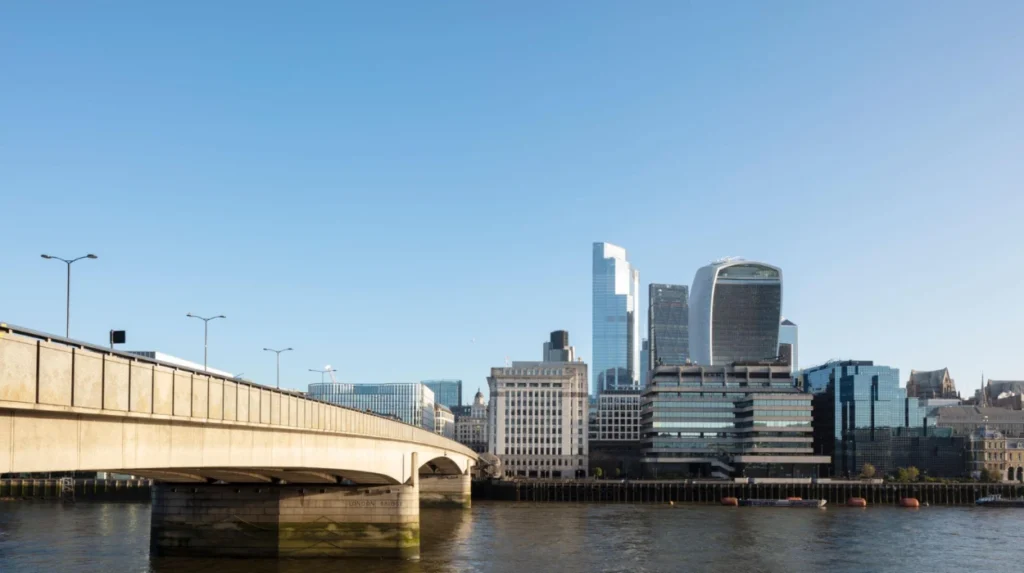
The current London Bridge opened in 1973 and replaced a nineteenth-century structure designed by engineer John Rennie. While the modern bridge prioritises functionality rather than ornamentation, its location provides exceptional access to some of London’s most important landmarks.
For visitors, the walk combines architectural observation, historical exploration, and riverside sightseeing within a compact area. Unlike many urban crossings, London Bridge places pedestrians within walking distance of markets, museums, churches, archaeological sites, and riverfront attractions.
The bridge also serves as a geographical marker. It stands between the Pool of London to the east and central Westminster-oriented London to the west, creating a natural observation point for understanding the city’s development along the Thames.
What can visitors see from London Bridge?
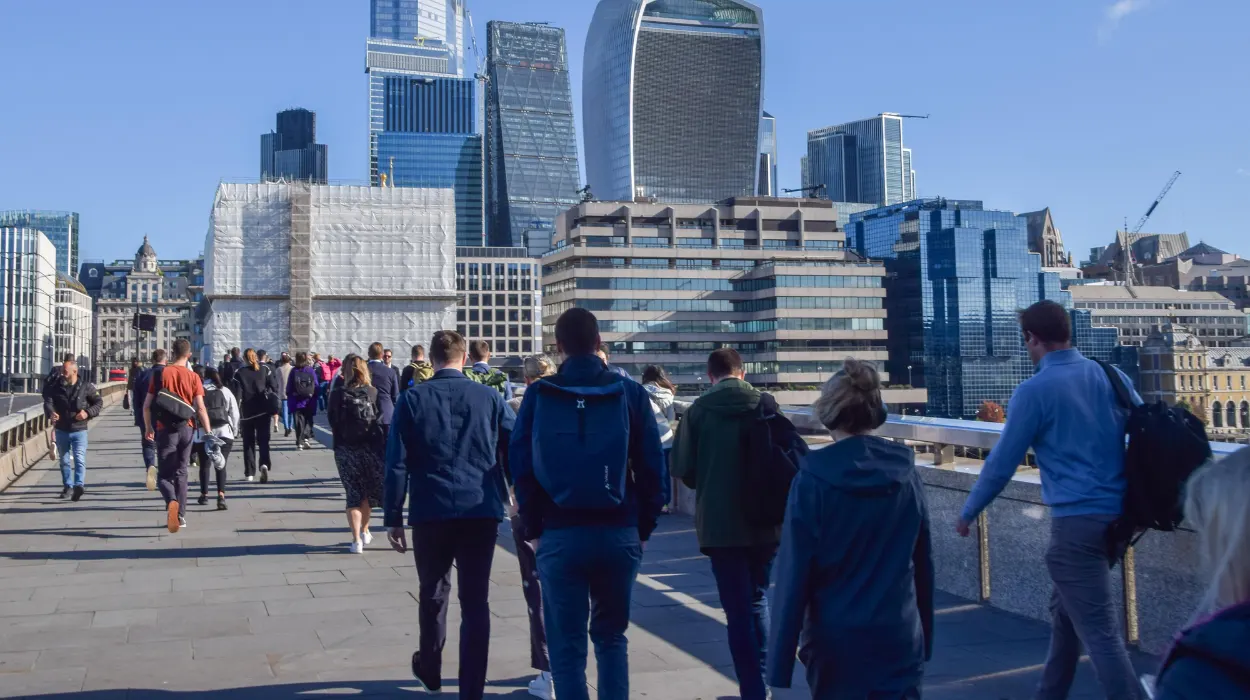
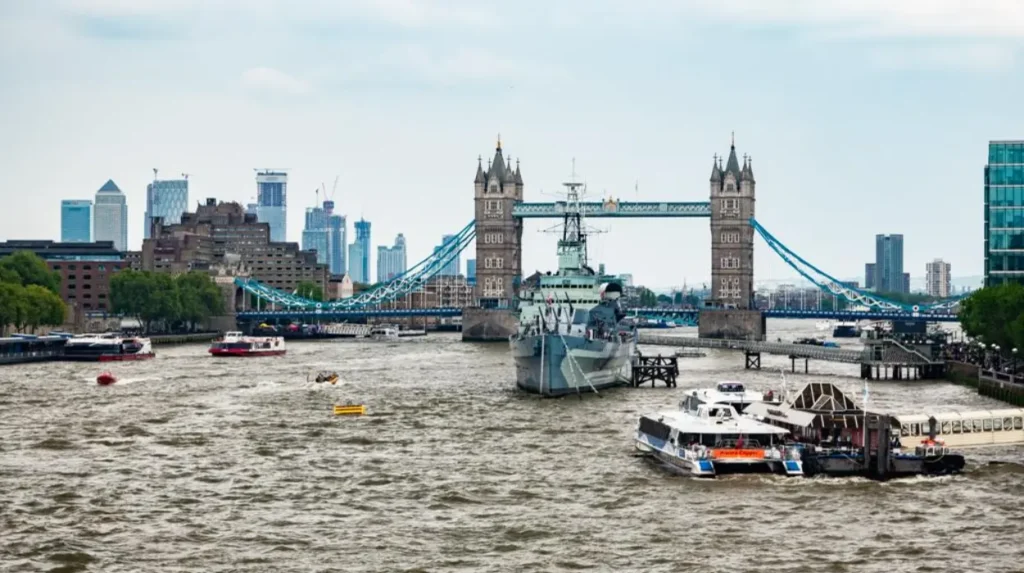
London Bridge offers uninterrupted views of the River Thames, Tower Bridge, the Tower of London, The Shard, HMS Belfast, and the evolving London skyline. The bridge’s elevated position creates clear sightlines toward both historic monuments and modern architectural landmarks.
One of the most celebrated views from London Bridge faces east. Pedestrians can see the iconic structure of Tower Bridge spanning the Thames. Completed in 1894, Tower Bridge remains one of London’s most photographed landmarks and represents Victorian engineering achievement.
Beyond Tower Bridge stands the historic fortress of Tower of London. Founded by William the Conqueror around 1078, the castle served as a royal residence, treasury, prison, and military stronghold.
Looking west, visitors can observe the curve of the Thames as it flows through central London. This perspective highlights how the river shaped urban expansion over successive centuries.
On the southern side of the bridge rises The Shard, completed in 2012. Standing 310 metres tall, it remains one of the tallest buildings in the United Kingdom and represents London’s twenty-first-century architectural transformation.
The bridge also overlooks HMS Belfast, a preserved Royal Navy cruiser launched in 1938. Today, the vessel operates as a museum documenting naval operations during the Second World War and post-war conflicts.
During sunrise and sunset, the bridge provides particularly clear photographic opportunities as natural light reflects across the river and illuminates the surrounding architecture.
How did London Bridge shape the development of London?
London Bridge functioned as London’s primary Thames crossing for centuries, directing commerce, settlement patterns, taxation systems, and transportation networks. Its strategic location enabled economic growth and transformed London into a major European commercial and political centre.
The first bridge at this location was constructed by Roman authorities around AD 50. Roman Londinium depended on reliable river crossings to support military logistics and trade.
After the Roman withdrawal from Britain in the fifth century, successive wooden bridges occupied the site. These structures frequently suffered damage from fires, storms, and military conflicts.
A major turning point occurred in 1176 when construction began on a new stone bridge under the supervision of priest and engineer Peter of Colechurch. Completed in 1209, the medieval London Bridge survived for more than 600 years.
The medieval bridge functioned as more than a transportation route. Buildings lined both sides of the structure, creating a densely populated commercial district. Shops, residences, chapels, and workshops occupied the bridge itself.
Traffic crossing London Bridge connected merchants from northern England, southern England, and continental Europe. Goods including wool, cloth, wine, grain, and imported luxury products moved through this corridor.
The bridge also influenced taxation and municipal administration. Toll collection generated revenue for maintenance and public works. Control of the crossing strengthened the authority of the City of London.
Archaeological excavations conducted along the Thames have uncovered foundations, artefacts, and structural remains associated with earlier bridge phases. These discoveries provide evidence of continuous occupation and commercial activity spanning nearly two millennia.
Which historic attractions are located near London Bridge?
The area surrounding London Bridge contains some of London’s most significant historic attractions, including Southwark Cathedral, Borough Market, the Tower of London, and archaeological remains connected to Roman, medieval, and early modern London.
The bridge serves as a gateway to several important heritage destinations within walking distance.
Southwark Cathedral
Southwark Cathedral traces its origins to a religious community established before the Norman Conquest. The current Gothic structure contains architectural elements dating from the thirteenth century.
The cathedral preserves memorials, medieval craftsmanship, and connections to literary figures associated with London. Its location near the bridge reflects Southwark’s historic importance as a commercial and religious centre.
Borough Market
Borough Market represents one of London’s oldest market sites. Historical records indicate market activity in the area for many centuries.
Today the market combines historic trading traditions with contemporary food culture. Its proximity to London Bridge makes it one of the city’s most visited attractions.
Roman and Medieval Southwark
Southwark developed as an important settlement outside the jurisdiction of the medieval City of London. Archaeological investigations have revealed Roman roads, buildings, pottery, and burial sites throughout the district.
These findings demonstrate the area’s long-standing role in transportation and commerce.
The Monument
The Monument to the Great Fire of London stands a short walk north of London Bridge. Designed by Christopher Wren and Robert Hooke, it commemorates the Great Fire of 1666.
The structure provides historical context for understanding London’s reconstruction after one of the most significant disasters in its history.
To experience this historic landmark in person today, consult our comprehensive [The Story of London Bridge: From Roman Origins to Modern Landmark] for itineraries and visiting parameters.
How does London Bridge connect to London’s architectural history?
London Bridge illustrates the evolution of engineering, urban planning, and architectural priorities from Roman timber construction to modern steel-and-concrete infrastructure. Each bridge reflected the technological capabilities and economic needs of its historical period.
The history of London Bridge can be divided into several major construction phases.
The Roman bridge relied primarily on timber construction techniques common throughout the Roman Empire.
The medieval stone bridge represented a significant engineering achievement. Its multiple arches supported buildings, defensive features, and heavy commercial traffic.
The bridge’s design influenced London’s urban form for centuries. Narrow passageways and dense construction created congestion but also maximised commercial opportunities.
By the eighteenth century, structural deterioration and increased traffic created pressure for replacement.
Engineer John Rennie designed a granite bridge completed in 1831. This structure featured wider spans and improved navigation for river traffic.
Remarkably, the nineteenth-century bridge was purchased in 1968 by entrepreneur Robert P. McCulloch and relocated to Lake Havasu City in the United States, where it remains a tourist attraction.
The current bridge opened in 1973. Designed to accommodate modern transportation demands, it carries vehicles, pedestrians, and cyclists across the Thames while maintaining the historic crossing location.
This sequence of rebuilding demonstrates how infrastructure evolves in response to changing economic and social requirements.
What cultural and educational sites can be explored nearby?
The London Bridge area contains museums, galleries, historic churches, and educational institutions that document London’s political, maritime, architectural, and social history through preserved artefacts, exhibitions, and research collections.
Several cultural institutions lie within a short walking distance of the bridge.
HMS Belfast
The preserved warship HMS Belfast provides detailed exhibitions covering naval operations, shipboard life, and twentieth-century military history.
Visitors can explore multiple decks, operational equipment, and reconstructed living quarters.
The Clink Museum
The Clink Prison Museum occupies a site associated with one of England’s oldest prisons.
Exhibits examine historical legal systems, punishment practices, and the development of criminal justice in medieval and early modern England.
Hay’s Galleria
Hay’s Galleria occupies a restored nineteenth-century warehouse complex.
The site illustrates the transformation of London’s riverside commercial infrastructure into mixed-use public spaces during the late twentieth century.
Archaeological Collections
Institutions throughout central London preserve artefacts recovered from excavations near London Bridge and Southwark.
These collections include Roman coins, ceramics, construction materials, personal possessions, and commercial records that help historians reconstruct everyday life across multiple historical eras, for example Roman Britain, medieval London, and the Tudor period.
How has the River Thames influenced the London Bridge experience?
The River Thames determined the location, importance, and continued relevance of London Bridge. The river shaped trade routes, settlement patterns, defence strategies, and economic growth while creating the visual landscape experienced by modern pedestrians.
The Thames is England’s longest river entirely within the country, extending approximately 346 kilometres. For centuries it functioned as London’s primary transportation corridor.
Before extensive railway development, river transport moved substantial quantities of goods into and out of the city. London Bridge became a crucial interface between land-based and river-based transportation systems.
The Pool of London, located downstream, served as a major commercial port. Ships arriving from Europe, Africa, Asia, and the Americas contributed to London’s emergence as a global trading centre.
Environmental factors also shaped bridge construction. Engineers needed to address tidal fluctuations, strong currents, and navigational requirements.
Modern visitors continue to experience the river’s significance through visible maritime activity, waterfront redevelopment, and preserved historic vessels.
The Thames also supports ongoing archaeological research. Low tides periodically reveal remnants of historic waterfront structures, providing new evidence about London’s development.
Why does London Bridge remain historically relevant today?
London Bridge remains historically relevant because it occupies a continuously used crossing site that reflects London’s evolution from Roman settlement to global metropolis. The bridge connects preserved heritage landscapes with modern urban development, making history visible within everyday city life.
Few locations in Europe demonstrate such prolonged continuity of use. The crossing has remained central to London’s transportation network for nearly 2,000 years.
The bridge represents multiple historical themes simultaneously. These themes include engineering innovation, urban growth, commercial expansion, political authority, and cultural exchange.
Conservation initiatives across the surrounding area preserve historic buildings, archaeological remains, and documentary records. Organisations including heritage agencies, museums, universities, and local authorities continue researching and interpreting the site’s history.
Digital mapping projects, archaeological surveys, and historical archives have expanded public understanding of London’s development. Researchers increasingly integrate documentary evidence with material discoveries to reconstruct earlier landscapes.
The London Bridge district also demonstrates how historic environments adapt to contemporary needs. Commercial offices, transport hubs, cultural venues, and residential developments coexist alongside medieval churches and archaeological sites.
For educators, the area functions as an open-air classroom illustrating urban history across multiple centuries, for example the Roman era, the medieval period, and modern London. For tourists, it provides direct access to some of the capital’s most significant attractions. For preservationists, it represents a successful example of integrating heritage conservation with modern city planning.
Walking across London Bridge therefore offers more than a simple river crossing. It provides a structured journey through London’s historical development, architectural evolution, and cultural heritage. Every view from the bridge reveals evidence of the forces that transformed a Roman trading settlement into one of the world’s most influential cities.
Is London Bridge free to walk across?
Yes, London Bridge is completely free for pedestrians. Visitors can walk across at any time and enjoy views of the River Thames, Tower Bridge, and the surrounding London skyline.