Key Points
- Discrimination Claims: David Ortiz, a resident of the luxury Altura 50 tower block in East Croydon, claims he is facing systemic discrimination after being banned from using on-site cycle storage facilities for his electric bicycle.
- Theft Incident: Following restrictions imposed by his tenancy agreement that barred him from keeping his e-bike indoors or within communal cycle hubs, Mr Ortiz was forced to park the vehicle on the street, where it was subsequently stolen.
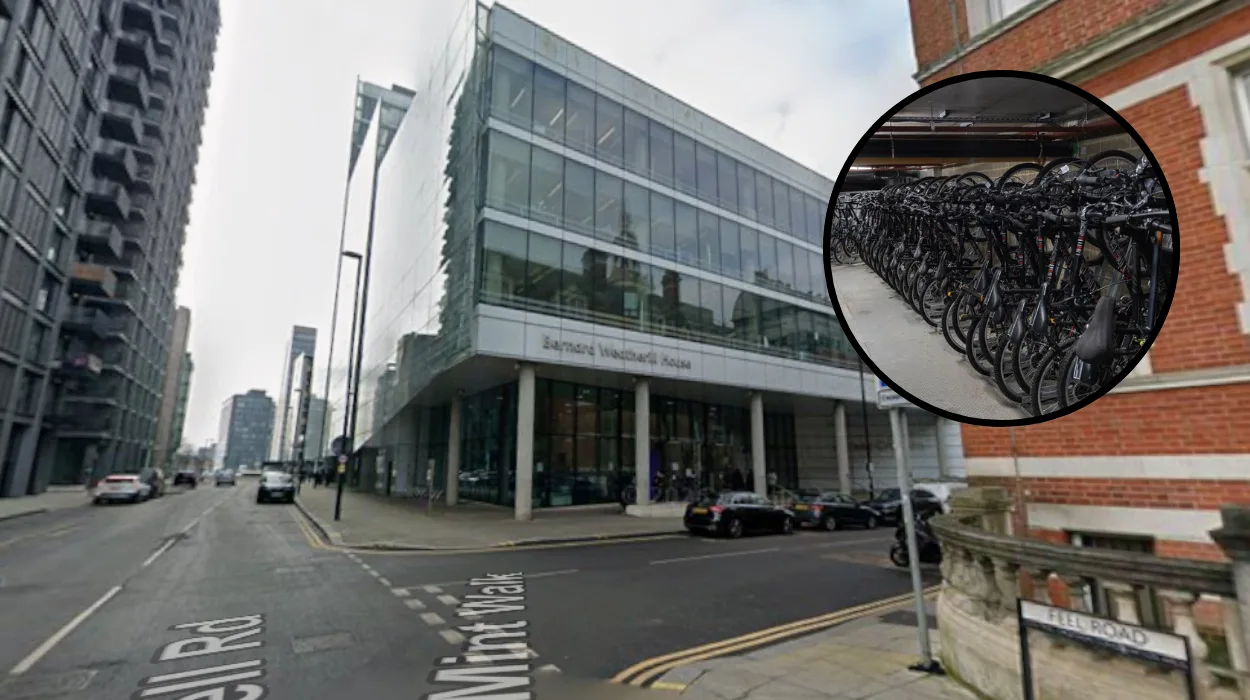
- Severe Storage Shortage: Investigation reveals that despite the building being marketed as a progressive, “car-free” green development, three of the four on-site cycle hubs are locked or repurposed, rendering over 70 per cent of designated spaces completely unusable for residents.
- Planning Breach Investigation: Croydon Council has officially launched a planning enforcement case against the building’s management company to determine if withholding cycle amenities violates original development permissions.
- Regulatory Conflict: The restrictions on e-bikes run entirely counter to Croydon’s Local Plan and wider London Transport strategies, which explicitly mandate the inclusion of secure charging infrastructure and active travel provisions for high-density modern housing.
Croydon (Extra London News) June 8, 2026 – A resident of a landmark luxury tower block in East Croydon has levelled accusations of discrimination against building management after being prohibited from using on-site cycle facilities for his electric bicycle, an enforcement action he claims directly led to the theft of his property. David Ortiz, an occupier of the Altura 50 complex situated on College Road, revealed that his e-bike was stolen last year after management enforced restrictive tenancy clauses that barred e-bikes from communal residential hubs. The dispute has now escalated into a local government investigation, with Croydon Council formally opening a planning enforcement case against the building’s operator to determine whether the closure of cycle storage spaces constitutes a material breach of the development’s original planning permissions.
- Key Points
- Why is an Altura 50 resident claiming discrimination over e-bike rules?
- How did the building’s cycle policy lead to a high-value theft?
- What did an inspection reveal about Altura 50’s cycle storage facilities?
- Why is Croydon Council launching a planning enforcement investigation?
- Does the e-bike ban violate Croydon’s Local Plan?
- How have Transport for London and local authorities responded?
- What impact has the cycle storage shortage had on other residents?
Why is an Altura 50 resident claiming discrimination over e-bike rules?
The controversy centres on the internal rules enforced at Altura 50, a prestigious residential address in South London. As reported by Local Democracy Reporter Harrison Galliven of MyLondon, David Ortiz, who has resided in the building since August of last year, argues that the management’s rigid policy targeting electric bicycles isolates a growing demographic of sustainable commuters. Speaking directly during an interview with Harrison Galliven of the Local Democracy Reporting Service (LDRS), Mr Ortiz stated:
“I am being discriminated against because I have an e-bike. It is strange because cycling is part of where the world is going.”
The crux of the resident’s grievance lies in a specific clause embedded within his tenancy agreement. According to the coverage by Harrison Galliven of MyLondon, this contract explicitly prohibits the storage of electric bicycles anywhere inside the structural boundaries of the building. Mr Ortiz claims that no justifiable safety rationale, risk assessment, or logistical explanation was ever provided by the landlords or property operators to support this blanket ban. This left him in a position where his primary mode of transport was treated with distinct regulatory prejudice compared to traditional manual bicycles.
How did the building’s cycle policy lead to a high-value theft?
The real-world consequences of the building’s internal regulations manifested in financial and personal loss for the resident. As Harrison Galliven of MyLondon reported, because Mr Ortiz was strictly barred from bringing his electric vehicle into the secure on-site storage hubs or his private flat, he had no alternative but to park the bicycle on the public street outside the tower block.
The vulnerabilities of street parking in a busy metropolitan area were quickly exploited. Writing for MyLondon, Harrison Galliven documented that Mr Ortiz’s e-bike was subsequently targeted by thieves and stolen in January of last year. Mr Ortiz points out that electric bicycles represent a substantial financial investment and are frequently targeted by organized criminal syndicates, making secure indoor storage an absolute necessity rather than an optional luxury feature. The policy, he argues, systematically exposes e-bike owners to a disproportionately high risk of property crime compared to other residents.
Explore More Croydon News
E-Bike Discrimination Claims Spark Council Investigation at Luxury Tower Block: Croydon 2026
What did an inspection reveal about Altura 50’s cycle storage facilities?
Frustrated by the theft of his property and what he perceived as a systemic failure by property management, Mr Ortiz initiated an investigative audit into the layout and availability of the building’s cycle facilities. The findings from this investigation revealed a significant discrepancy between the building’s architectural promises and its operational reality.
As reported by Harrison Galliven of the LDRS, Altura 50 is widely recognized as Europe’s tallest volumetric modular building—a skyscraper assembled from factory-constructed units built off-site—housing nearly 1,000 residential apartments. Completed in 2022, the architectural design was heavily praised and approved as a sustainable, largely “car-free” urban development scheme. To offset the deliberate lack of vehicle parking infrastructure, the tower was legally required to provide 259 dedicated cycle parking spaces, offering residents direct, green transport links to nearby East Croydon station.
However, the physical reality inside the tower paints a profoundly different picture. During an on-site inspection conducted alongside Harrison Galliven of MyLondon, Mr Ortiz demonstrated that the vast majority of these green amenities are completely locked away from public use. The journalist observed that Compass Rock International, an asset management firm that has recently assumed operational control of the Altura 50 development, was keeping only a small fraction of the cycle parking infrastructure accessible to the paying tenants.
Specifically, Harrison Galliven of the LDRS verified that out of the 239 cycle parking spaces legally designated for the sole use of residents, a mere 78 spaces were actually unlocked and available at the time of the physical tour. This means that roughly 67 per cent of the building’s residential cycle infrastructure is currently blocked from deployment.
The LDRS reporter provided a detailed breakdown of the internal spaces, noting that one of the primary basement cycle storage hubs was entirely locked shut against resident key fobs. Upon closer inspection, this vital space had been completely repurposed by building workers and was being used as an improvised storage depot for building furniture, tins of paint, and general building maintenance equipment. Furthermore, two alternative cycle hubs within the tower block complex were similarly found to be entirely inaccessible to the inhabitants of the nearly 1,000 flats.
Why is Croydon Council launching a planning enforcement investigation?
The extensive closure and repurposing of these communal spaces have raised serious questions regarding statutory compliance and municipal planning violations. According to the findings published by Harrison Galliven of MyLondon, Mr Ortiz believes that the ongoing operational restrictions constitute an explicit failure to comply with the binding planning requirements originally mandated by local government authorities when granting development rights for the tower block.
In response to formal complaints regarding these missing amenities, local government officials have chosen to intervene. As confirmed by statements obtained by Harrison Galliven of the LDRS, a spokesperson for Croydon Council stated:
“The council’s planning enforcement team has recently opened an enforcement case and is investigating whether the current use of these areas is in line with the planning permission and conditions attached to the development.”
If the local authority’s planning enforcement team determines that the asset management company or the building owners are deliberately withholding, reducing, or repurposing cycle spaces that were a mandatory condition of the building’s initial approval, the management could face severe statutory notices. This could legally compel them to clear out the maintenance gear and return all 259 cycle spaces back to their legally intended function.
Does the e-bike ban violate Croydon’s Local Plan?
The internal ban implemented by the building’s management stands in stark contrast to the explicit sustainable transport directives enforced by the local borough. As detailed by Harrison Galliven of MyLondon, Croydon’s Local Plan—the statutory document that sets out the strict design and environmental rules for all new real estate developments within the borough—specifically addresses the evolution of personal transport.
The Local Plan clearly mandates that high-density residential schemes must actively incorporate secure, dedicated charging areas specifically designed for electric bicycles and mobility scooters. Furthermore, it requires developers to construct specialized, larger spatial layouts tailored to accommodate cargo bikes and adapted cycles for disabled residents. By completely outlawing e-bikes through tenancy terms and failing to provide functional charging zones, the management framework at Altura 50 appears to directly contradict the progressive active-travel benchmarks championed by local government planners.
How have Transport for London and local authorities responded?
The ongoing restriction of cycling infrastructure at the College Road site is particularly controversial given the history of the building’s post-completion planning applications. As uncovered by Harrison Galliven of the LDRS, management had previously attempted to retroactively alter their spatial allocations, seeking official permission to scale back on some of their cycling commitments.
However, this move faced swift institutional pushback. Reports from the LDRS confirm that both Croydon Council’s planning board and Transport for London (TfL) formally lodged strenuous objections to any proposed reduction in active travel facilities. In their official warning notices, TfL explicitly stated that the requested management modifications would dangerously degrade parking provisions that were already hovering below the absolute minimum levels demanded under the overarching London Plan policy. The London Plan is a grand regional strategy designed to aggressively promote active travel, reduce carbon emissions, and clean up the capital’s air by transitioning commuters away from fossil-fuel vehicles.
Despite these high-level regulatory rejections from TfL and local councillors, Mr Ortiz highlights that the actual state of the building has remained unchanged. The primary basement storage hubs continue to be locked away from the public, demonstrating an apparent disregard for both institutional directives and the practical day-to-day needs of the tower’s residents.
What impact has the cycle storage shortage had on other residents?
The systemic closure of three major storage hubs has caused widespread logistical friction for the broader residential community inside the tower. Because the available bike infrastructure has been artificially choked down from 259 spaces to just 78, the remaining operational zones have become heavily congested.
As reported by Harrison Galliven of MyLondon, Mr Ortiz described the daily chaos that residents face when trying to park their alternative vehicles securely. The remaining open areas are constantly overcrowded, turning a simple task into a stressful daily scramble. Describing the physical reality of using the restricted spaces, Mr Ortiz told the LDRS:
“I had to manoeuvre my bike into a new space because it was so packed.”
This severe overcrowding has left many of the building’s hundreds of residents with very few viable choices. Mr Ortiz emphasizes that because the internal communal spaces are overflowing and e-bikes are banned by the landlord’s rules, a massive number of residents have been left with no choice but to leave their transport equipment exposed on the public streets. This created an ideal environment for local opportunistic bike thieves, resulting in an increased risk of property theft across the entire community.
Mr Ortiz concludes that the current management setup is an unacceptable failure for a project that won its planning approvals by marketing itself as a forward-thinking, eco-friendly environment. Expressing his final assessment to Harrison Galliven of MyLondon, Mr Ortiz stated:
“They are supposed to provide this… it’s supposed to be a car-free development.”