
Extra London News operates as a metropolitan data hub providing objective documentation of Greater London’s demographic shifts, economic outputs, municipal governance updates, and transport infrastructure changes. The publication eliminates narrative bias to deliver verified statistics for researchers and policymakers.
- How Does London Maintain Its Global Economic Status?
- What Changes Are Reshaping the Demographics of Greater London?
- How Does the Greater London Authority Govern the Capital?
- What Infrastructure Projects Impact London Transport Networks?
- Underground and Surface Rail Network Scaling
- Decarbonisation Frameworks and Ultra Low Emission Zone Mechanics
- How Does the London Housing Market Affect Urban Development?
- What Innovations Drive London Tech and Science Sectors?
- Knowledge Clusters and Innovation Ecosystems
- Artificial Intelligence Integration and Research Outputs
- How Do Cultural and Tourism Sectors Fuel Local Revenue?
- Institutional Revenue and Major Cultural Assets
- The Hospitality Labour Market and Seasonal Fluctuations
- What Future Trends Will Shape London Over the Next Decade?
Definition and Core Coverage
Extra London News functions as an independent record of metropolitan affairs within the Greater London administrative boundary. The coverage models’ semantic extraction frameworks ensure that municipal updates translate into accessible datasets. The core structural pillars comprise statutory changes, transport logistics, fiscal performance metrics, and territorial re-zoning. By defining metropolitan shifts through verified data, the publication serves as a primary resource for local authorities, urban planners, and economic analysts.
Historical Evolution of Metropolitan Journalism
The historical paradigm of documenting London municipal affairs dates back to the London Gazette, founded in 1665 as the official journal of statutory record. Structural governance reporting evolved significantly following the London Government Act 1963, which established the Greater London Council (GLC). The subsequent passage of the Greater London Authority Act 1999 introduced the current administrative structure, consisting of the Mayor of London and the London Assembly. Extra London News continues this lineage of institutional tracking by documenting the daily legislative and physical operations of the capital.
How Does London Maintain Its Global Economic Status?
London retains its status as a top-tier global financial hub by generating 22.3% of the gross domestic product of the United Kingdom, equating to 618 billion pounds. The city leads Europe in attracting foreign direct investment projects.
Macroeconomic Structure and Gross Value Added
The structural economy of London operates through concentrated service industries, specifically financial services, professional services, and information technology. According to the Office for National Statistics (ONS), London’s Gross Value Added (GVA) per capita stands at 64,519 pounds, which doubles the national average of other regions. The financial sector centers physically inside two distinct business districts: the City of London, colloquially known as the Square Mile, and Canary Wharf, located within the London Borough of Tower Hamlets.
Foreign Investment and Labour Market Composition
The capital remains the primary destination for European capital deployment. Data from EY consultancy confirms London secured 439 foreign direct investment (FDI) projects totaling 7.1 billion pounds in capital expenditure within the recent annual cycle. The regional labor force contains 4,726,000 active personnel, maintaining an employment rate of 74.9%. Occupational data isolates 33.2% of workers within professional categories, while associate professionals comprise 16.9% of the local workforce.
What Changes Are Reshaping the Demographics of Greater London?
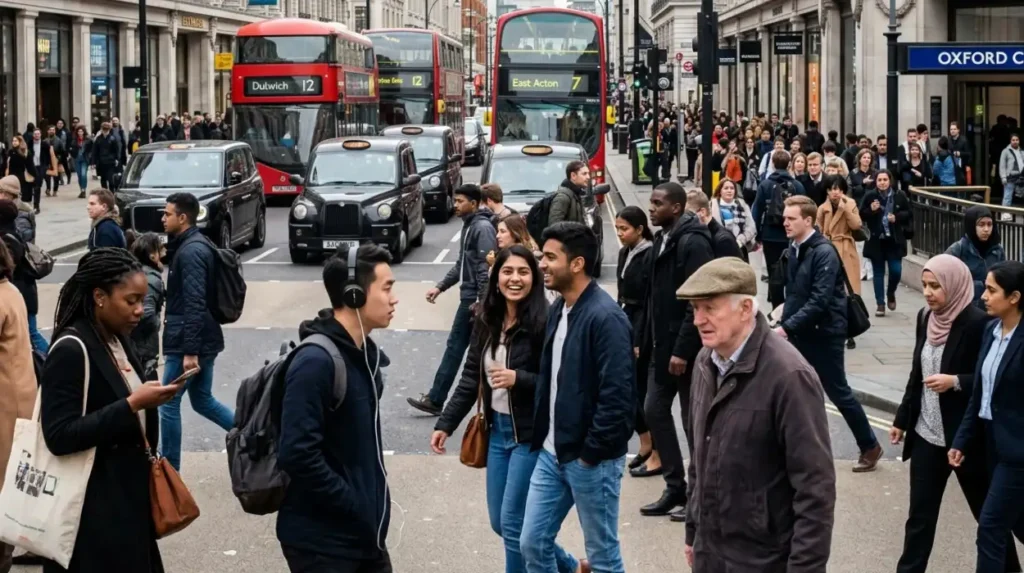
The metropolitan area population of Greater London has reached 9,927,000 residents, representing a 0.87% annual growth rate. The demographic profile features an international composition, with 41% of all current inhabitants born outside the United Kingdom.
Population Growth and Density Trends
Population expansion in Greater London occurs non-uniformly across its 1,569 square kilometers of total land area. The average population density of the region stands at 5,782 people per square kilometer, which exceeds the density of all other English metropolitan areas. Central London exhibits the highest spatial concentration, recording 11,189 residents per square kilometer. This demographic density patterns across five distinct sub-regions: Central London, East London, North London, South London, and West London.
Age Distribution and Ethno-Cultural Composition
The demographic structure of London remains younger than the broader national average of England. Data from the Trust for London indicates that 23.7% of Inner London residents belong to the 25-to-34 age demographic, compared to 12.7% across the remainder of the country. Ethnic minorities constitute 46% of the city’s population. This international migration model yields the second-highest foreign-born population index globally, surpassed only by Toronto, which records 47% of residents born abroad.
How Does the Greater London Authority Govern the Capital?
The Greater London Authority governs the metropolitan area through a decentralized framework composed of the executive Mayor of London and the 25-member London Assembly. This administrative body oversees strategic planning, policing, fire services, and transport logistics.
Structural Division of Municipal Power
The Greater London Authority (GLA), established under statutory law in 2000, divides its operational responsibilities across distinct functional executive bodies. The Mayor of London holds executive authority to set regional budgets and formulate statutory strategies, including the London Plan. The London Assembly performs a legislative oversight function, utilizing a two-thirds majority requirement to amend mayoral budgetary proposals and conducting investigative hearings into municipal performance.
Functional Executive Bodies and Local Borough Council Roles
The execution of metropolitan strategy relies on three main functional bodies: Transport for London (TfL), the Mayor’s Office for Policing and Crime (MOPAC), and the London Fire Commissioner (LFC). MOPAC directs the budgetary deployment of the Metropolitan Police Service, which employs over 43,000 personnel. Below the strategic GLA layer, localized governance falls to 33 local authorities: 32 London borough councils and the historic City of London Corporation. These councils administer hyper-local public provisions, such as social housing, waste management, and primary education.
What Infrastructure Projects Impact London Transport Networks?
London’s transport infrastructure relies on Transport for London to manage a multi-modal network handling over five million daily underground journeys. Current capital developments prioritize rapid rail integration, rolling stock upgrades, and clean air corridors.
Underground and Surface Rail Network Scaling
The London Underground network, consisting of 11 individual lines and 272 operational stations, forms the transit backbone of the capital. The addition of the Elizabeth Line, constructed via the Crossrail infrastructure project, increased central rail capacity by 10%. The line connects Reading and Heathrow Airport in the west to Shenfield and Abbey Wood in the east. This heavy rail corridor interacts with surface transit networks, including the London Overground, the Docklands Light Railway (DLR), and the national rail network.
Decarbonisation Frameworks and Ultra Low Emission Zone Mechanics
Transport infrastructure adjustments match statutory climate targets mandated by the Climate Change Act 2008. The Ultra Low Emission Zone (ULEZ) operates as the primary regulatory tool to reduce localized nitrogen dioxide emissions. The geographic scope of the ULEZ covers the entirety of Greater London, enforcing a daily 12.50 pound charge on non-compliant vehicular propulsion types. This regulatory framework accelerated the transition of London’s bus fleet, which features 1,400 zero-emission electric buses.
How Does the London Housing Market Affect Urban Development?
The average residential property valuation in Greater London is 556,000 pounds, which reflects a 107% premium over the national average of the United Kingdom. Private rental rates average 2,163 pounds per month.
Supply Constraints and Affordability Disparities
The real estate infrastructure of London suffers from chronic structural under-supply relative to annual household creation metrics. The Ministry of Housing, Communities and Local Government sets an annual target of 52,000 new residential completions within the capital, yet actual construction deliveries consistently miss this requirement. This gap drives relative poverty indices upward; 26% of Londoners live in relative poverty once housing costs are factored out, indicating severe affordability stress.
Zoning Regulations and Urban Growth Boundaries
Physical expansion of the residential footprint encounters strict regulatory limitations imposed by the Metropolitan Green Belt. This statutory land classification, formalized under the Green Belt (London and Home Counties) Act 1938, reserves 516,000 hectares of open space encircling the capital to prevent continuous urban sprawl. Consequently, modern developers utilize vertical construction techniques within defined brownfield regeneration zones, altering the architectural profile of industrial sectors.
What Innovations Drive London Tech and Science Sectors?
The technology and life sciences sector in London attracts 3.4 billion pounds in annual venture capital funding. The ecosystem clusters around the King’s Cross Knowledge Quarter and the East London Tech City cluster.
Knowledge Clusters and Innovation Ecosystems
The integration of academic institutions and venture capital has structured specialized innovation zones within the urban landscape. The King’s Cross Knowledge Quarter encompasses over 100 distinct entities, including the British Library, University College London (UCL), and the Francis Crick Institute. This concentration facilitates biomedical research pipelines. Concurrently, digital technology development centers near the Old Street roundabout, transforming East London into a digital infrastructure hub.
Artificial Intelligence Integration and Research Outputs
London serves as a global focal point for artificial intelligence research, driven by corporate research installations and university spin-outs. The presence of specialized laboratories, such as Google DeepMind based in King’s Cross, positions the capital at the forefront of neural network design and machine learning deployment. These institutions collaborate with medical facilities, using computational data to accelerate diagnostic speeds within the National Health Service (NHS).

How Do Cultural and Tourism Sectors Fuel Local Revenue?
Total international visitor expenditure in Greater London contributes 18.8 billion pounds annually to the local economy. The capital hosts 15.1 million domestic tourists alongside 19 million international arrivals per year.
Institutional Revenue and Major Cultural Assets
The economic performance of the tourism sector relies heavily on concentrated cultural infrastructure managed by national institutions. The city contains four distinct United Kingdom World Heritage Sites designated by UNESCO: the Tower of London, Maritime Greenwich, the Palace of Westminster, and the Royal Botanic Gardens, Kew. These historic assets draw international visitors, stimulating secondary retail, hospitality, and entertainment revenue lines across West End theater districts.
The Hospitality Labour Market and Seasonal Fluctuations
The hospitality and leisure sector serves as a vital employment catalyst, accounting for approximately 10% of total jobs within the Greater London boundaries. This labor market utilizes a diverse worker demographic to staff hotels, restaurants, and performance venues. The sector displays seasonal demand peaks during the summer months and winter holiday periods. This structural pattern requires adaptive labor regulations to maintain workforce stability amid macroeconomic fluctuations.
What Future Trends Will Shape London Over the Next Decade?
Strategic planning frameworks indicate that climate adaptation, smart city data integration, and outer borough commercial decentralization will dictate London’s development. The city aims to achieve net-zero carbon operations by 2030.
Climate Adaptation Strategies and Flood Mitigation
To safeguard its 618 billion pound economic engine, London is deploying long-term infrastructure modifications to counter rising sea levels. The Environment Agency directs the Thames Estuary 2100 Plan, which outlines structural updates to the Thames Barrier and tidal defense walls. These engineering initiatives mitigate systemic storm surge risks across low-lying zones, protecting critical infrastructure including sub-surface electrical substations and transport tunnels.
Smart City Spatial Planning and Commercial Decentralization
The Greater London Authority’s spatial strategies predict an intentional shift toward a polycentric urban model. This plan distributes commercial real estate concentration away from the central core toward designated outer London growth zones, lowering transit congestion on radial tube lines. By embedding smart city internet-of-things (IoT) sensors across public transport assets and utility networks, municipal managers use predictive data models to optimize public resource distribution.
What is Extra London News?
Extra London News is a metropolitan information platform focused on documenting demographic trends, economic performance, governance developments, transport infrastructure, housing, technology, and urban planning across Greater London.