Key Points
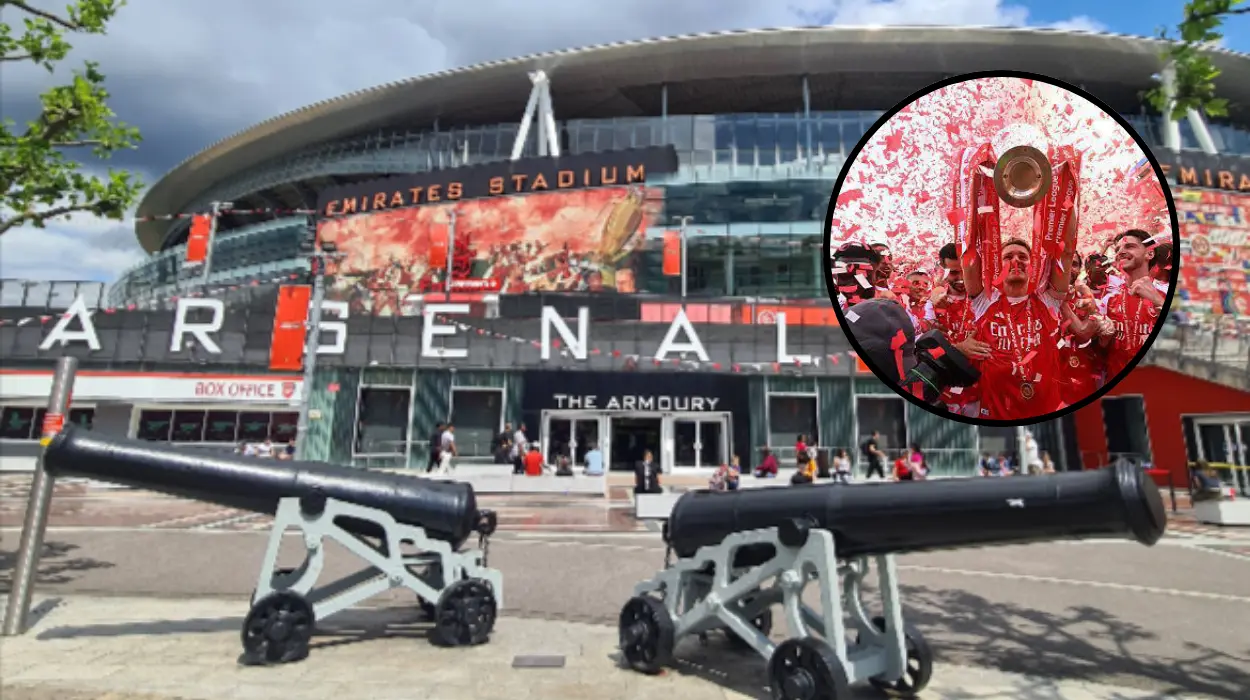
- Historic Triumph: Arsenal Football Club has successfully secured the Premier League title, bringing a painful 22-year drought to a definitive end by finishing seven points clear of Manchester City.
- Double-Decker Celebration: The club will host an expansive open-top bus parade through the streets of Islington on Sunday, featuring four customised vehicles to accommodate the massive celebratory crowds.
- Unified Club Presence: Both the men’s and women’s senior squads are confirmed to participate together in the civic event, showcasing the structural unity of the North London institution.
- Silverware Exhibition: The celebratory procession will prominently display multiple trophies, with the women’s team showcasing the UEFA Women’s Champions League trophy alongside the iconic Premier League crown.
- Heartbreak in Budapest: The event follows a dramatic encounter in the UEFA Men’s Champions League final, where Mikel Arteta’s side suffered an agonising penalty shootout defeat against Paris Saint-Germain in Hungary.
London (Extra London News) June 6, 2026 – Arsenal Football Club are finalizing preparations for a historic civic victory parade through the streets of North London this Sunday to celebrate their first Premier League title in more than two decades. The celebratory event, which will see four open-top buses transport players, coaching staff, and senior executives through the London Borough of Islington, is scheduled to commence at 14:00 BST. In a significant display of structural unity, the parade will formally integrate both the men’s and women’s senior squads. The women’s team will present their recently won UEFA Women’s Champions League trophy to the public, while the men’s senior squad will present the Premier League trophy, which they secured following a gruelling domestic campaign that concluded with the club finishing seven points clear at the summit of English football.
- Key Points
- When and Where Does the Arsenal Title Parade Take Place?
- Which Trophies Will Be Displayed During the Celebration?
- How Did the Women’s Team Secure European Glory?
- How Did the Men’s Squad End Their Long Domestic Drought?
- What Happened in the Champions League Final in Budapest?
- How Did the Match Unfold in Normal Time?
- What Tensions and Controversies Occurred During Extra Time?
- How Did the Penalty Shootout Conclude in Heartbreak?
- What are the Practical Arrangements for Fans Attending the Parade?
The public celebrations occur against a complex competitive backdrop for the men’s senior squad, occurring less than 24 hours after a highly emotional and physically exhausting encounter in Continental competition. Head coach Mikel Arteta led his team into the UEFA Men’s Champions League final against French champions Paris Saint-Germain at the Puskás Aréna in Budapest, Hungary. Despite a disciplined tactical display and an early opening goal from German forward Kai Havertz, the match ultimately concluded in a 1-1 draw after extra time, leading to a dramatic 4-3 penalty shootout defeat for the North London side. Consequently, while the parade remains a joyous celebration of domestic supremacy, it also serves as an immediate moment of collective recovery for a squad that fell agonizingly short of securing an unprecedented European and domestic double.
When and Where Does the Arsenal Title Parade Take Place?
What Is the Route of the Open-Top Bus Procession?
As documented by the editorial staff of the Premier League’s official media channel, the celebratory procession is designed to weave through the heart of the club’s traditional geographical footprint in North London. The four open-top buses are scheduled to depart from the staging area at 14:00 BST on Sunday, moving deliberately through the packed thoroughfares of Islington. The route has been carefully co-ordinated with local municipal authorities and the Metropolitan Police to accommodate the hundreds of thousands of spectators expected to line the streets.
The procession will culminate in a massive public gathering in the immediate vicinity of the Emirates Stadium. According to operational summaries published by the league’s media team, vast crowds of supporters have already begun identifying key viewing positions along the designated roads. Aerial logistics maps indicate that the local council has authorized extensive road closures extending from the historic high streets of Islington directly to the stadium concourses to ensure public safety during the multi-hour event.
Which Trophies Will Be Displayed During the Celebration?
How Did the Women’s Team Secure European Glory?
As reported by the statistical logging staff of Google Sports Data, the Arsenal Women’s Football Club enjoyed a highly distinguished continental campaign in the 2025/26 UEFA Women’s Champions League, culminating in them lifting the most prestigious trophy in European club football. The journey to the title featured a series of highly competitive knockout ties that tested the depth and tactical resolve of the squad.
In the round of 16, the Arsenal women’s side demonstrated their clinical efficiency over a two-legged tie against Belgian outfit Oud-Heverlee Leuven. The first leg, contested at the King Power At Den Dreef Stadium on 11 February 2026, concluded in a commanding 4-0 victory for the visitors. The return fixture on 18 February 2026 at Borehamwood Football Club reinforced their dominance, resulting in a 3-1 home win and an aggregate score of 7-1.
The quarter-final stage presented a formidable domestic challenge in the form of London rivals Chelsea FC Women. In the first leg, held before a passionate crowd at the Emirates Stadium on 24 March 2026, Arsenal secured a vital 3-3 draw under intense pressure. The definitive moment of the tie occurred during the second leg at Stamford Bridge on 1 April 2026, where a disciplined defensive performance guided Arsenal to a 1-0 victory, securing a narrow 4-3 aggregate triumph.
The semi-final stage pitted the Gunners against French powerhouse Olympique Lyonnais Féminin. The first leg at the Emirates Stadium on 26 April 2026 saw Arsenal extract a narrow 2-1 advantage. Although the return leg at the Groupama Stadium on 2 May 2026 saw Lyon claim a 3-1 victory on the night, Arsenal’s resilience throughout the broader tournament structure ultimately paved the way for their eventual coronation as European champions, a piece of silverware that will be proudly paraded on Sunday.
How Did the Men’s Squad End Their Long Domestic Drought?
The primary catalyst for the weekend’s public celebrations is the conclusion of the club’s 22-year wait for the English top-flight championship. As detailed by historical match reports from Google Sports Data, Mikel Arteta’s squad successfully navigated a demanding 38-game campaign to break a cycle of three successive second-placed finishes behind Manchester City.
Arsenal concluded the domestic season at the top of the table with a cumulative total of 85 points, establishing a comfortable seven-point margin over Pep Guardiola’s Manchester City. The final weeks of the campaign showcased the squad’s consistency, characterized by a series of high-stakes victories. On 2 May 2026, the club secured a definitive 3-3 home victory against Fulham at the Emirates Stadium, followed by a tense 1-0 away victory against West Ham United at the London Stadium on 10 May 2026.
The final matches of the domestic calendar solidified their title credentials. The Gunners recorded a 1-0 victory over Burnley at the Emirates Stadium on 18 May 2026, before concluding their league itinerary with a 2-1 away triumph against Crystal Palace at Selhurst Park on 24 May 2026. This consistent run of form ensured that the Premier League trophy would return to North London for the first time since the legendary “Invincibles” campaign of 2003/04.
Explore More Islington News
Arsenal Victory Parade Route, Timings, and Road Closures: London 2026
What Happened in the Champions League Final in Budapest?
How Did the Match Unfold in Normal Time?
As reported by the live commentary team of Olympics.com in their detailed match narrative from Budapest, the UEFA Men’s Champions League final at the Puskás Aréna on 30 May 2026 was a tactical battle of immense physical proportions. Mikel Arteta deployed a highly compact defensive strategy, which saw Arsenal record just 24.7 per cent possession—the lowest statistical figure recorded in a Champions League final since advanced data tracking began.
Despite the lack of sustained possession, the English champions struck with devastating efficiency early in the match. In the 5th minute of play, German international Kai Havertz intercepted a clearing attempt by Paris Saint-Germain defender Marquinhos that had deflected off Leandro Trossard. Havertz collected the ball 40 yards from goal, outpaced the recovering defensive line, and delivered a precise, high finish past PSG goalkeeper Matvey Safonov from a restricted angle to give Arsenal a 1-0 lead.
The French champions, managed by Luis Enrique, gradually dictated the tempo of the contest, retaining 64 per cent possession and consistently probing Arsenal’s central defensive block. The tactical breakthrough for the Parisian side occurred in the 64th minute when Georgian winger Khvicha Kvaratskhelia made a rapid overlapping run into the left side of the penalty area. He was brought down by a mistimed challenge from Arsenal right-back Cristhian Mosquera, prompting referee Daniel Siebert to immediately award a penalty kick. In the 65th minute, Ousmane Dembélé stepped up to the spot and converted the penalty, sending Arsenal goalkeeper David Raya the wrong way to equalise.
What Tensions and Controversies Occurred During Extra Time?
According to the technical match report compiled by journalists covering the event for the Champions League Final 2026 broadcasting syndicate on YouTube, the intensity of the encounter escalated significantly during the 30 minutes of extra time, as both sets of players suffered from severe physical fatigue. In the 77th minute of normal time, Arsenal had been kept level by a remarkable instinctive save from young midfielder Myles Lewis-Skelly, who deflected a fierce, redirected strike from Kvaratskhelia onto the woodwork.
The central point of controversy occurred in the 103rd minute of play. Arsenal forward Noni Madueke driving into the penalty box, appeared to be brought down under a heavy challenge from Paris Saint-Germain left-back Nuno Mendes. Referee Daniel Siebert dismissed the intense appeals from the Arsenal players and technical bench, refusing to award a penalty or initiate a formal VAR pitchside review.
The decision provoked a furious response from the English club’s contingent. Midfielder Declan Rice and manager Mikel Arteta were both issued yellow cards for their vehement protests on the touchline. This emotional expenditure further drained the squad as they navigated the final minutes of extra time, with both managers forced to substitute exhausted attacking options ahead of the final whistle.
How Did the Penalty Shootout Conclude in Heartbreak?
As detailed in the archival broadcast footage from the Champions League Final 2026 sports record on YouTube, the match proceeded to a high-stakes penalty shootout under the lights of the Puskás Aréna to determine the club champions of Europe. Paris Saint-Germain elected to take the first penalty kick in front of a capacity crowd of 61,035 spectators.
The sequence of the sudden-death shootout unfolded as follows:
- Round 1: Gonçalo Ramos opened the scoring for Paris Saint-Germain with a composed strike. Arsenal’s replacement forward, Viktor Gyökeres, immediately responded with a successful conversion to leave the score tied at 1-1.
- Round 2: Désiré Doué converted his attempt to give the French side a 2-1 advantage. Arsenal’s Eberechi Eze then stepped forward but dragged his spot-kick wide of the post, handing PSG a distinct psychological advantage.
- Round 3: Nuno Mendes attempted to solidify the lead for the Parisians, but his shot was brilliantly saved by David Raya. Declan Rice then stepped up under immense pressure to convert his penalty, restoring parity at 2-2.
- Round 4: Moroccan international Achraf Hakimi calmly scored for Paris Saint-Germain. Arsenal’s Gabriel Martinelli matched his effort with a clinical strike into the corner to bring the score to 3-3.
- Round 5: Lucas Beraldo scored the fifth penalty for Paris Saint-Germain, leaving no room for error for the final English penalty taker. Defender Gabriel Magalhães stepped up needing to score to send the shootout into sudden death, but his striking effort failed to find the back of the net, ending the contest.
The resulting 4-3 shootout victory allowed Paris Saint-Germain to secure back-to-back European crowns, becoming the first football club to successfully defend the title since Real Madrid achieved the feat in 2018. The official match awards named PSG midfielder Vitinha as the Player of the Match for his influential role in dictating play. For Arsenal, the defeat added an unwanted statistical record to their history; the North London institution extended their record as the club with the most matches played in the history of the competition (226) without ever lifting the European Cup.
What are the Practical Arrangements for Fans Attending the Parade?
How Will Local Authorities Manage Public Transport and Safety?
As reported by journalists covering the logistical planning for the Premier League’s official digital platform, the Islington Council and Transport for London have formulated a comprehensive crowd management strategy for Sunday afternoon. Due to the high volume of foot traffic anticipated along the route, several Underground stations in the immediate vicinity of the Emirates Stadium and Highbury fields will operate under restricted entry and exit parameters to prevent overcrowding on the platforms.
Municipal safety officials have advised supporters to arrive well in advance of the 14:00 BST start time to secure stable viewing positions. Emergency medical stations and temporary public amenities are being deployed along the parade path. The local authority has issued warnings that strict public order regulations will be enforced, including prohibitions on the use of industrial pyrotechnics and flares within the crowded urban corridors.
What Expressions of Support Have the Players Received?
According to digital media compilations verified by the Premier League’s communications desk, the Arsenal playing squad has expressed profound gratitude for the unwavering commitment of their fan base throughout the demanding season. Images published across official club channels show prominent first-team figures, including club captain Martin Ødegaard, William Saliba, and Bukayo Saka, thanking fans for their support.
Despite the profound disappointment of the European final in Hungary, the prevailing sentiment within the club remains heavily focused on the historic nature of their domestic achievement. The open-top bus parade is viewed by the club’s executive management as an essential opportunity to consolidate the emotional bond between the team and the local community, turning the red sector of North London into a massive venue of celebration after more than two decades of waiting.
For a visual breakdown of the dramatic match that preceded this parade, you can watch the UCL Final 2026 Penalty Shootout Highlights. This recording captures the full length of the tense penalty shootout in Budapest, providing context to the mixed emotions the men’s squad carries into the weekend’s celebrations.