Key Points
- A new MRP poll by JL Partners for the London School of Economics suggests Labour and the Green Party are neck-and-neck in Camden, at 32% and 33% respectively.
- Camden is currently dominated by Labour, which holds 44 councillors, compared with one Green, six Liberal Democrats, three Conservatives and one independent.
- The Standard reported that Sir Keir Starmer could see Labour lose control of his north London council in the May 7 local elections.
- Professor Tony Travers of LSE London said polling suggests Labour could lose control of Camden and may have to rely on the Liberal Democrats or Conservatives to stay in power.
- Camden has almost always been run by Labour since its creation in 1965, apart from a Conservative administration from 1968 to 1971 and a period of no overall control from 2006 to 2010.
- The poll points to a wider London shift, including a Green surge in Inner London, Reform UK gains in Outer London, and Labour losses across several boroughs.
- The Standard said the result could amount to the most profound change in London politics since 1968, when Labour was wiped out by the Conservatives.
- Other boroughs highlighted in the modelling include Haringey, Newham, Lewisham, Hackney, Barking and Dagenham, Wandsworth, Barnet, Croydon, Bexley, Hillingdon, Bromley and Merton.
- Tom Lubbock of JL Partners said small swings against Labour could cost it a swathe of councils because margins are extremely tight.
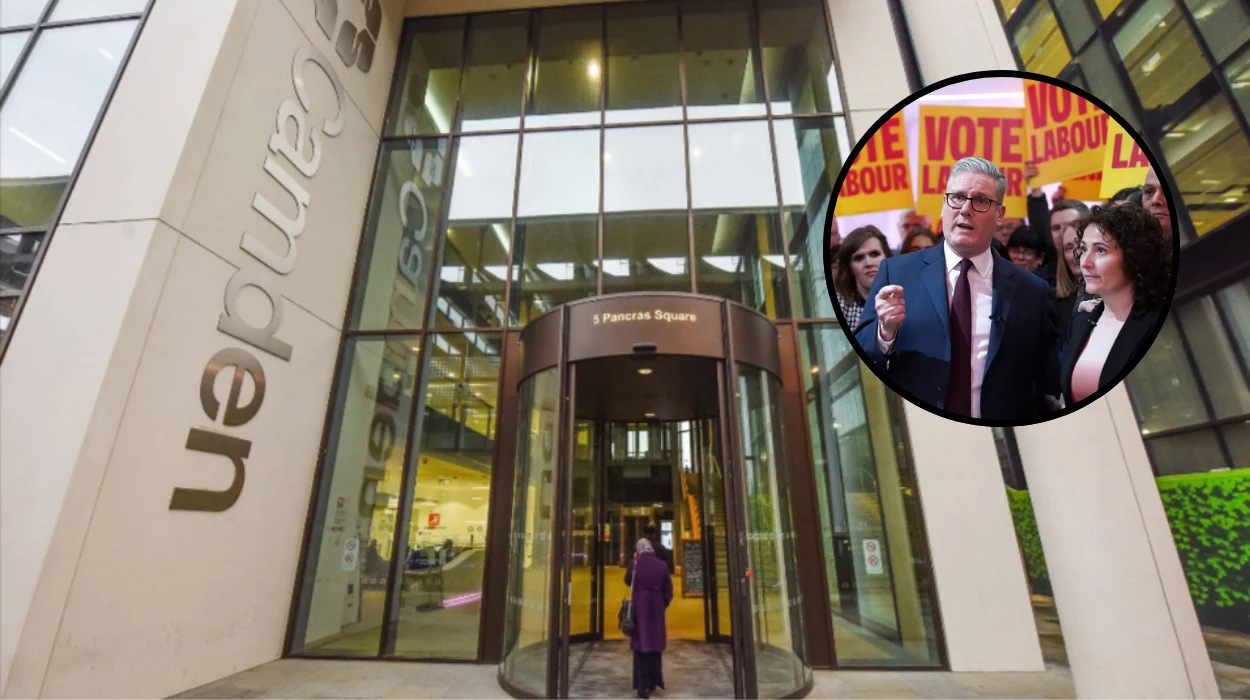
London (Extra London News) April 27, 2026 – Sir Keir Starmer could face one of the sharpest political reversals of his leadership if Labour loses control of Camden council in the May 7 local elections, according to a new poll reported by The Standard. The MRP survey, carried out by JL Partners for the London School of Economics, put the Greens on 33% in Camden and Labour on 32%, a margin that could upend a borough long treated as a Labour fortress.
Could Labour really lose Camden?
As reported by The Standard, the poll suggests Labour’s hold on Camden is no longer secure, despite the party’s deep historic dominance in the borough.
Camden currently has 44 Labour councillors, while the Greens have just one, and the borough also contains six Liberal Democrats, three Conservatives and one independent.
Professor Tony Travers, director of LSE London, told The Standard that polling suggests Labour could lose control of Camden and
“end up having to rely on the Liberal Democrats or Conservatives if they want to stay in power”.
He added that Labour could also try to run a minority administration, though that would depend on support from other parties.
Why is Camden so significant?
Camden matters because it is not just any local authority; it includes Sir Keir Starmer’s constituency of Holborn and St Pancras.
The borough has been under Labour control for most of the last six decades, making any loss there politically symbolic as well as numerically important.
The Standard reported that Camden has only twice broken with Labour rule since its creation in 1965: between 1968 and 1971 under the Conservatives, and from 2006 to 2010 when there was no overall control. That history is why the current polling is being framed as a major shock rather than a routine local election swing.
What does the poll say about London?
The wider picture from the JL Partners modelling, as reported by The Standard, points to a strong Green advance in Inner London and bigger Reform UK gains in Outer London.
Labour is also projected to fall behind in several boroughs it currently controls, with its vote share down by an average of 15 points across the capital.
The Standard said the Greens are projected to emerge as the clear second force across much of Inner London, with Haringey on 37%, Newham level with Labour on 34%, Lewisham on 35%, and Hackney showing Labour on 40% to the Greens’ 37%.
In Barking and Dagenham, Labour’s support is forecast to fall from about 80% in 2022 to 44%, although it would still remain ahead of other parties.
Where else are the main battlegrounds?
The Standard reported that Labour, the Conservatives, the Greens, Reform UK and the Liberal Democrats are all shaping a highly fragmented contest across the capital.
The Conservatives are leading in Wandsworth, by 27% to Labour’s 24%, and are effectively tied with Labour in Barnet at 24% and 25%.
The modelling also suggests the Conservatives could see support fall sharply in Croydon, Bexley, Hillingdon and Bromley, while Reform UK is forecast to make its strongest gains in outer east London. Reform is said to be picking up 40% in Havering, and may also gain Bexley, while it trails the Conservatives in Bromley.
What are the Liberal Democrats doing?
As reported by The Standard, the Liberal Democrats are also competitive in parts of London, with Merton identified as a key target council. The poll puts the Lib Dems ahead of Labour there, by 31% to 23%.
That makes the local elections more than a two-party story. The Standard’s report suggests a fractured political landscape in which small shifts in turnout or vote distribution could decide control of numerous councils.
Why does this matter for Labour?
The political significance goes beyond Camden itself. The Standard quoted Professor Travers saying the result could mark
“the most profound change to London’s politics since the shocking result of 1968, when Labour was wiped out by the Conservatives”.
Tom Lubbock, co-founder of JL Partners, told The Standard that the Greens, Reform and independents are making enough inroads that “a small swing against Labour would mean them losing a swathe of councils”. He said control of many councils could come down to very fine margins, making the outcomes highly volatile.
What happens next?
The local elections are due on May 7, and the poll suggests the contest in Camden may become one of the most closely watched in London.
If Labour does lose control, it would raise questions not only about the party’s local organisation but also about the strength of its support in boroughs tied closely to the prime minister’s own political base.
For now, the survey does not predict a certain outcome, but it does show that Labour’s grip on Camden is under real pressure. The Standard’s reporting, backed by JL Partners’ modelling and Tony Travers’ assessment, points to a London-wide election that could redraw local power in a way not seen for decades.