Mayfair is one of London’s most historically significant districts. Its reputation for wealth, architecture and social status developed through a specific process of landownership, urban planning and cultural change. What began as largely open land on the western edge of London became a carefully planned Georgian neighbourhood whose streets, squares and buildings continue to define its identity.
- How did Mayfair get its name and what existed there before the district was built?
- Why did the Grosvenor family become so important to Mayfair’s history?
- How did eighteenth-century London create the conditions for Mayfair’s growth?
- How did Grosvenor Square become the centre of historic Mayfair?
- What architectural style made Mayfair’s streets famous?
- How did Mayfair’s streets and neighbourhoods change during the Victorian era?
- How did Mayfair become associated with British wealth and prestige?
- What happened to Mayfair during the twentieth century?
- How is Mayfair’s historic character protected today?
- What historic features can still be seen in Mayfair today?
- Why does Mayfair remain historically important to London?
- What is the lasting legacy of Mayfair’s elegant streets and prestigious reputation?
- Frequently Asked Question
The district occupies a prominent position in the West End of London, close to Hyde Park, St James’s and the historic centres of royal and political power. Its location helped establish its importance, but geography alone did not create Mayfair’s prestige. The transformation depended on the development of the Grosvenor Estate, the growth of eighteenth-century London, the construction of high-quality housing and the long-term management of valuable urban land.
The name itself preserves an earlier stage of the area’s history. Mayfair was named after the annual May Fair, an event that operated in the area during the late seventeenth and eighteenth centuries. The fair disappeared, but its name became permanently attached to one of Britain’s best-known residential districts.
Understanding Mayfair therefore requires looking beyond luxury shops and expensive property. Its elegant streets represent more than 300 years of metropolitan development, architectural preservation and changing patterns of British society.
How did Mayfair get its name and what existed there before the district was built?
Mayfair took its name from the annual May Fair, while the surrounding area was originally rural land of fields, pasture and gardens on London’s western edge before large-scale eighteenth-century development transformed it into an elite residential district.
Before Mayfair became part of fashionable London, the landscape looked very different. The area formed part of the wider Manor of Ebury, a historic estate west of the old City of London. Much of this land remained open countryside for centuries.
The district’s name came from the May Fair, a seasonal public event associated with entertainment, trading and popular recreation. The fair had earlier locations and moved to the Mayfair area during the late seventeenth century. It became sufficiently well known for the surrounding district to acquire its permanent name.
The fair represented a very different social environment from the controlled and prestigious neighbourhood that later emerged. Public fairs attracted traders, entertainers and large crowds. As aristocratic residential development expanded nearby, the social character of the fair increasingly conflicted with the ambitions of wealthy landowners and residents.
The fair was eventually suppressed during the eighteenth century. Its disappearance reflected a broader transformation in London’s urban geography. Land that had supported temporary public gatherings was becoming increasingly valuable for permanent residential construction.
What did the landscape look like before urban development?
The western edge of London contained fields, pasture and market gardens. London had not yet expanded across the area in the dense form associated with the modern metropolis.
The location nevertheless had important advantages. It stood west of the increasingly crowded historic centre and close to the royal court at St James’s. Wealthy residents wanted healthier and less congested residential environments than those found in older parts of London.
This demand created the conditions for planned expansion. Mayfair became part of a wider movement that pushed London’s residential development into former countryside during the eighteenth century.
The transition from open land to a structured urban district was therefore both a demographic and economic process. London’s population and commercial influence were expanding, while wealthy households sought houses close to political and royal institutions.
Why did the Grosvenor family become so important to Mayfair’s history?
The Grosvenor family’s ownership of major landholdings provided the foundation for Mayfair’s development because the estate controlled planning, building leases and long-term property management from the eighteenth century onward.
The defining event in Mayfair’s landownership history occurred in 1677. Sir Thomas Grosvenor married Mary Davies, an heiress connected with extensive landholdings in the Manor of Ebury.
Through this marriage, land west of London entered the Grosvenor family’s estate. The acquisition became one of the most consequential examples of aristocratic landownership in British urban history.
The Grosvenor family did not simply sell the land and withdraw from the area. The estate developed and managed property over successive generations. This long-term ownership created an organised framework for urban planning.
Grosvenor records trace the family’s association with London property to the 1677 marriage and identify the development of Mayfair during the 1720s as a major stage in the organisation’s history.
How did estate ownership shape Mayfair’s streets?
Large estates had the ability to coordinate development across substantial areas. This differed from districts created through many unrelated landowners making independent decisions.
The Grosvenor Estate could influence street layouts, building standards and lease arrangements. The result was a more coherent urban environment.
In 1720, Sir Richard Grosvenor commissioned planning work for the family’s Mayfair estate. Historic England records that surveyor Thomas Barlow prepared a development plan based around spacious streets and a major garden at its centre.
This planning model became central to Mayfair’s identity. The district was designed as a residential environment rather than growing organically from medieval streets and commercial routes.
The regularity of the street pattern still contributes to the area’s visual character. Straight streets, formal squares and carefully positioned buildings established a recognisable structure that survived later periods of redevelopment.
How did eighteenth-century London create the conditions for Mayfair’s growth?
Rapid population growth, expanding national wealth, relative political stability and the movement of affluent households toward the West End created strong demand for new residential districts such as Mayfair during the eighteenth century.
London changed dramatically during the eighteenth century. It was already one of Europe’s largest cities and continued to expand economically and geographically.
The older urban core contained crowded housing, commercial activity and intense traffic. Wealthy residents increasingly looked westward for new homes with more space and better access to parks and royal institutions.
The West End became particularly attractive because of its proximity to the Court of St James’s and later its connections with the wider royal landscape around Hyde Park and Buckingham Palace.
Grosvenor identifies the eighteenth century as a period when economic growth, expanding trade and urban development encouraged the creation of new districts beyond London’s traditional boundaries. Mayfair emerged within this wider process.
Why was location so important to Mayfair’s social status?
Mayfair stood close to the institutions that shaped elite British society. The royal court, Parliament, aristocratic residences and important social venues were concentrated within central and western London.
Location reduced the practical distance between private residences and public influence. Members of the aristocracy and political establishment could live in large houses while remaining close to centres of power.
Hyde Park also increased the district’s attractiveness. Access to open space was valuable in a rapidly expanding city.
The combination of proximity and planning created a strong social advantage. Mayfair was neither isolated countryside nor part of the densely developed commercial City of London. It occupied a strategically valuable position between elite institutions and urban amenities.
This relationship between location and status remained important through later centuries.
How did Grosvenor Square become the centre of historic Mayfair?
Grosvenor Square became the planned centre of Mayfair because eighteenth-century estate development placed a major garden square within a grid of residential streets, creating an architectural and social focus for the new neighbourhood.
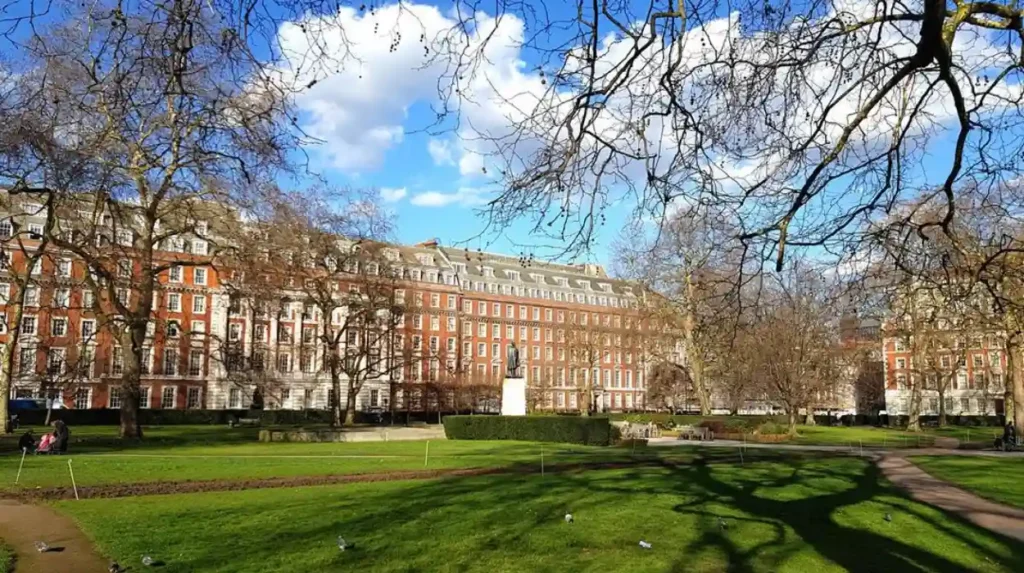
Grosvenor Square is one of the most important surviving elements of Mayfair’s original urban plan.
Historic England records that the development scheme prepared for the Grosvenor Estate placed a substantial garden at the centre of a grid of spacious streets. The square helped attract wealthy residents by providing a prestigious setting for surrounding houses.
The garden square was more than decorative land. It represented a specific form of eighteenth-century urban planning.
What was the purpose of London’s garden squares?
Garden squares combined private residential development with landscaped open space. Houses faced a central garden, creating a formal visual relationship between architecture and greenery.
This arrangement offered advantages unavailable in many older parts of London. Residents gained access to an organised environment with open views and a recognisable communal centre.
Historic England describes Grosvenor Square as an early and important example of a major garden incorporated into a planned London residential development. Its early landscape included turf, trees, shrubs and formal boundaries.
The square therefore helped establish the physical language of Mayfair: substantial houses, broad streets and controlled green spaces.
Its historical role later expanded beyond residential prestige. Grosvenor Square became associated with Anglo-American relations and contains memorials connected with the United States and the Second World War. Historic England specifically identifies the square’s post-war commemorative importance as part of its heritage significance.
What architectural style made Mayfair’s streets famous?
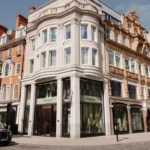
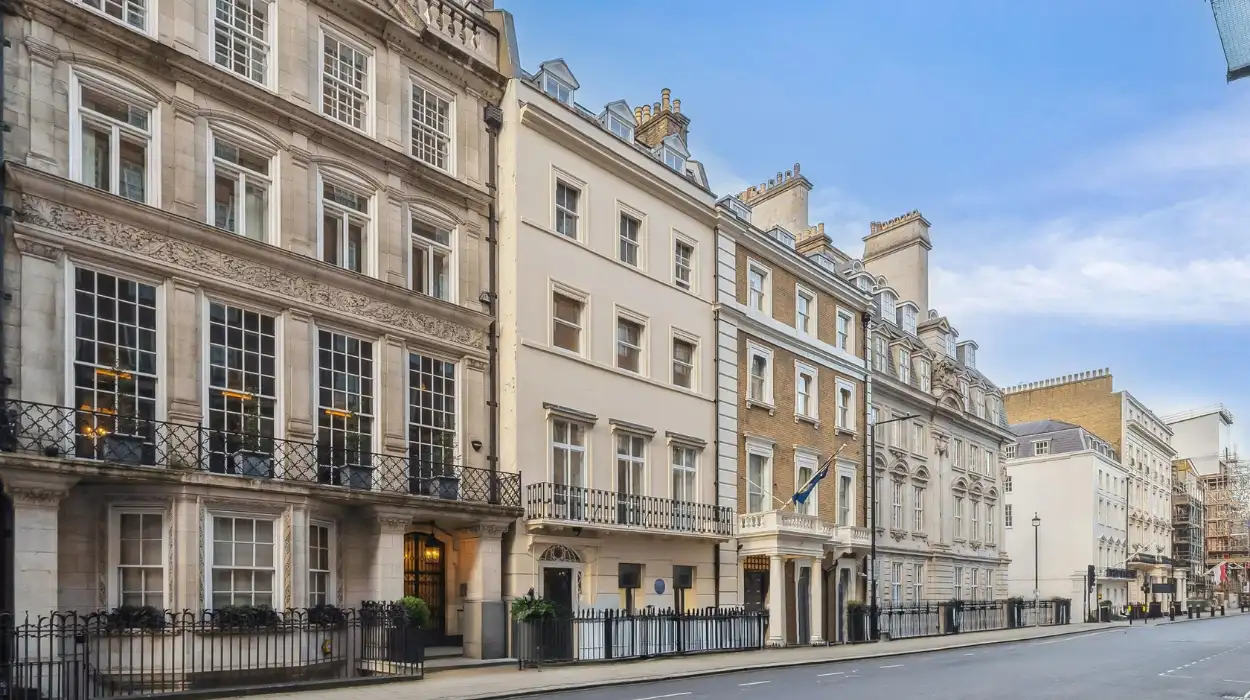
Mayfair became internationally recognised for its Georgian townhouses, formal streets and garden squares, while later Victorian, Edwardian and twentieth-century redevelopment added architectural layers without removing the district’s historic urban structure.
The strongest architectural association with historic Mayfair is Georgian London.
The Georgian period, covering the reigns of Kings George I through George IV, coincided with the district’s principal eighteenth-century development. Houses were designed for wealthy households and reflected the architectural standards expected in elite residential neighbourhoods.
Brick façades, symmetrical elevations, sash windows and formal proportions became defining characteristics of the area.
The surviving townhouses demonstrate the importance of construction quality and long-term adaptation. Historic England’s listings document numerous Mayfair buildings whose origins remain visible despite later alterations.
For example, 73 Grosvenor Street is listed as a Grade II building and dates principally from 1722–24. Its survival provides direct physical evidence of the earliest major phase of Mayfair’s development.
Why did Georgian townhouses suit aristocratic London?
The townhouse was designed for urban life among wealthy families. It provided multiple floors for different domestic functions while maintaining a formal public appearance.
Reception rooms often occupied principal levels, while servants and domestic functions operated in other parts of the building.
The architecture therefore reflected social organisation as well as aesthetic preferences. A Mayfair house was both a residence and a place where political, family and social relationships were maintained.
This residential model helped define the area’s prestige. Large houses required substantial financial resources to lease, furnish and staff.
Later generations altered many properties, but the underlying Georgian street pattern remained a major part of Mayfair’s identity.
How did Mayfair’s streets and neighbourhoods change during the Victorian era?
Victorian Mayfair retained its elite position but changed through commercial growth, architectural redevelopment and shifting residential patterns, creating new streetscapes that combined Georgian planning with nineteenth-century design and services.
Mayfair did not remain frozen after its eighteenth-century creation. London continued to grow throughout the nineteenth century, and the district adapted to new economic and social conditions.
The Victorian era brought major technological, commercial and demographic changes to the capital. Railways transformed movement across London. New retail businesses expanded. Professional occupations became increasingly important.
Mayfair’s proximity to central London made commercial activity more valuable over time.
Some streets developed stronger retail and service functions. Businesses increasingly served wealthy residents and visitors.
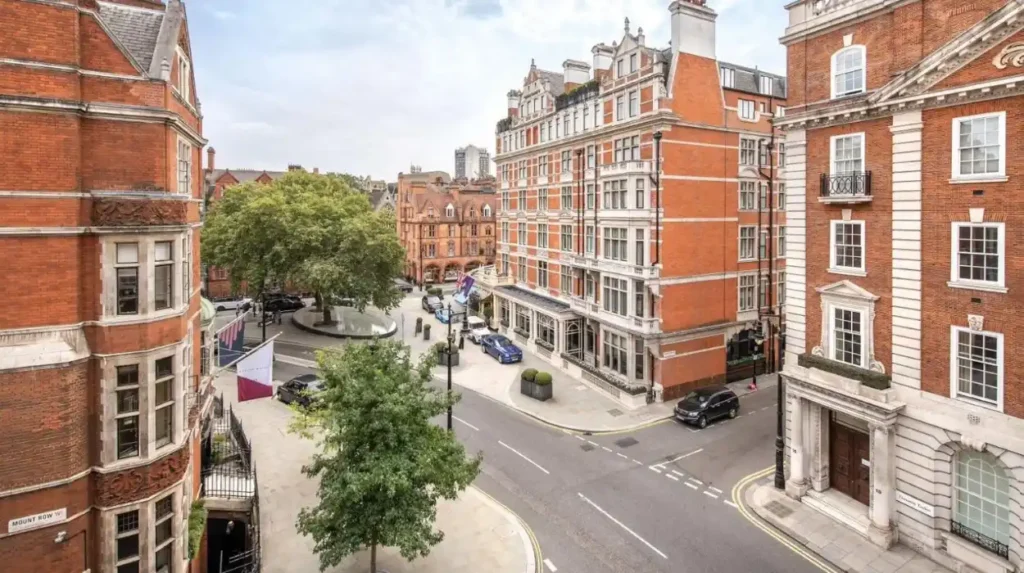
Mount Street became an important example of later architectural development. The area acquired distinctive nineteenth-century buildings, including red-brick and terracotta architecture associated with changing Victorian tastes.
The continued adaptation of Mayfair demonstrates an important principle of historic urban districts: preservation does not mean complete physical immobility. Buildings change use, are altered and are replaced, while the broader historical structure can survive.
How did the area balance housing and commerce?
Mayfair’s economic life developed alongside its residential character.
Tailors, jewellers, art dealers and specialist retailers established themselves in and around the district. Their presence reinforced Mayfair’s relationship with wealth and consumption.
Savile Row became internationally associated with bespoke tailoring, while Bond Street developed as one of London’s major luxury shopping locations.
These commercial activities were not separate from Mayfair’s historical identity. They developed because the district already contained wealthy residents and stood within the expanding West End.
The concentration of specialist businesses created a reinforcing cycle. Affluent residents attracted high-value services, and those services further strengthened the area’s reputation.
How did Mayfair become associated with British wealth and prestige?
Mayfair’s prestigious reputation developed through concentrated aristocratic residence, expensive property, proximity to political and royal institutions, high-quality architecture and the long-term establishment of luxury businesses serving affluent residents and international visitors.
Prestige is not created by a single building or event. Mayfair’s reputation developed through the interaction of several historical systems.
The first system was landownership. Large-scale estate control supported coordinated development.
The second was location. The district stood close to royal, political and social institutions.
The third was architecture. Spacious streets and substantial houses visibly distinguished Mayfair from more densely built districts.
The fourth was social concentration. Wealthy households established residences in the area, reinforcing its elite reputation.
The fifth was commerce. Luxury retailers and specialist businesses adapted to the demands of affluent customers.
Together, these examples created a durable association between Mayfair and high social status.
The reputation survived major changes in British society because the underlying location and property values remained powerful.
How did Mayfair’s reputation extend beyond Britain?
London became a global financial, political and cultural centre during the nineteenth and twentieth centuries.
International visitors increasingly encountered Mayfair through hotels, shopping streets, restaurants, diplomatic institutions and cultural businesses.
This exposure transformed a historically aristocratic residential district into an internationally recognised symbol of London luxury.
The name also entered popular culture. Mayfair became one of the most valuable properties represented on the British version of Monopoly, reflecting the district’s established association with expensive central London real estate.
Its international recognition therefore rests on both historical reality and cultural representation.
What happened to Mayfair during the twentieth century?
The twentieth century changed Mayfair through war, commercial expansion, diplomatic use and residential conversion, but the district retained its historic prestige because its central location, estate structure and architectural character remained economically valuable.
The First World War contributed to significant social change across Britain. Traditional patterns of aristocratic household life became harder to sustain.
Large houses increasingly changed function. Some became offices, diplomatic premises or commercial properties.
Grosvenor records that social changes associated with the First World War contributed to the conversion of several major Mayfair houses into embassies and diplomatic residences.
The Second World War created another major disruption.
Bombing damaged London extensively, while businesses and offices relocated in response to wartime conditions. The post-war city required reconstruction and economic adaptation.
According to Grosvenor’s historical account, wartime conditions contributed to businesses moving westward, while later planning and property changes affected the balance between office and residential use in Mayfair.
How did Mayfair remain valuable after aristocratic society changed?
The district’s survival did not depend entirely on the continuation of eighteenth-century aristocratic lifestyles.
Its value rested on durable assets: central location, historic architecture, established streets and proximity to major London institutions.
Properties could therefore change function while remaining valuable.
A townhouse could move from private residence to embassy, office or hotel without losing its position within the historic urban landscape.
This flexibility explains much of Mayfair’s longevity.
The district adapted to twentieth-century economic conditions without abandoning the geographical and architectural foundations established during the eighteenth century.
How is Mayfair’s historic character protected today?
Mayfair’s historic character is protected through listed-building legislation, conservation planning and long-term estate management, which regulate significant architectural change while allowing historic buildings and streets to continue serving residential, commercial and cultural functions.
Preservation is essential to understanding modern Mayfair.
London is a changing city, and historic districts face constant pressure from redevelopment, commercial demand and infrastructure requirements.
The protection of important buildings ensures that significant architectural evidence survives.
Historic England’s National Heritage List records numerous listed structures across the wider Mayfair area. Listed status recognises buildings and sites of special architectural or historic interest.
The listing of eighteenth-century buildings on streets such as Grosvenor Street demonstrates the survival of fabric from the district’s earliest major development phase.
What role do conservation areas play?
Westminster City Council operates within a borough containing 56 designated conservation areas.
These areas receive additional planning protection because of their special architectural and historic interest. Certain demolition and alteration proposals require additional controls to protect established character.
Conservation policy focuses on more than individual buildings.
A historic district includes streets, views, trees, public spaces and relationships between structures.
This broader approach is especially important in Mayfair. Its significance comes from the combined effect of streets, squares and architecture.
The preservation of one townhouse would not protect the complete historical meaning of the district. The relationship between buildings is equally important.
What historic features can still be seen in Mayfair today?
Modern Mayfair still preserves its eighteenth-century street pattern, Georgian townhouses, garden squares, historic commercial streets and later Victorian buildings, allowing visitors to identify physical evidence of the district’s development across more than three centuries.
The most important surviving feature is the urban layout itself.
The eighteenth-century grid remains visible across much of the district. Streets established during the original estate development continue to organise movement through Mayfair.
Grosvenor Square remains a central historic landmark. Its landscaping has changed over time, but its role within the planned neighbourhood remains clear.
Georgian townhouses survive throughout the district, although many have altered interiors and changed functions.
Later Victorian and Edwardian buildings provide additional historical layers.
Mayfair is therefore not a single-period museum. It is a working urban district containing evidence from different phases of London’s development.
To experience this historic landmark in person today, consult our comprehensive [Best Things to Do in Mayfair for Luxury Shopping, Dining, and Sightseeing Experiences] for itineraries and visiting parameters.
Why does Mayfair remain historically important to London?
Mayfair remains historically important because it provides a major surviving example of planned eighteenth-century urban development and demonstrates how aristocratic landownership, architecture, commerce and preservation shaped London’s modern West End over successive generations.
Mayfair offers evidence for several major themes in British history.
It demonstrates how land inherited through aristocratic families influenced the physical growth of London.
It documents the expansion of the eighteenth-century metropolis into former rural land.
It preserves important examples of Georgian urban planning.
It shows how architecture expressed social hierarchy.
It records the transition from aristocratic residential life to a mixed district containing homes, offices, embassies, hotels and luxury businesses.
The district also demonstrates the importance of long-term urban management. The Grosvenor Estate’s continued historical association with the area created an unusual continuity between the original development period and the modern city. Grosvenor identifies Mayfair as a central part of a London property history extending back to the 1677 acquisition of Ebury land.
What is the lasting legacy of Mayfair’s elegant streets and prestigious reputation?
Mayfair’s lasting legacy is its successful combination of eighteenth-century planning, historic architecture and continuous adaptation, which created a district whose prestige survived profound political, social and economic changes while preserving its fundamental urban identity.
The history of Mayfair is the history of transformation under conditions of continuity.
Open land became a seasonal fairground.
The fairground became an aristocratic residential district.
The residential district developed luxury commerce and international connections.
Historic houses changed into offices, embassies, hotels and modern residences.
Yet the essential framework survived.
The streets remain organised around the planning principles established during the eighteenth century. Garden squares continue to provide open spaces within dense central London. Historic buildings retain evidence of the people and institutions that shaped the district.
Mayfair’s prestigious reputation therefore has a documented historical foundation.
It was created through landownership, strategic location, planned development and sustained architectural investment. Its later association with luxury retail and international wealth developed from those earlier foundations rather than appearing independently.
For history enthusiasts, Mayfair provides a concentrated record of London’s westward expansion. For cultural tourists, it offers visible evidence of Georgian and Victorian architecture. For educators and students, it demonstrates the relationship between social power and urban form. For genealogical researchers, it connects family histories with one of Britain’s most influential aristocratic estates.
The district’s future historical relevance will depend on the same balance that has shaped it for centuries: preserving significant evidence while allowing a living city to change.
Mayfair remains prestigious because its past remains visible.
Its elegant streets are not simply attractive urban spaces. They are surviving records of how London grew, how wealth influenced architecture, how estates shaped neighbourhoods and how historic places continue to function within the modern capital.
From the former May Fair to Grosvenor Square, from Georgian townhouses to luxury commercial streets, Mayfair represents more than a famous London address. It represents a long and carefully documented chapter in the history of the British capital.
Frequently Asked Question
Why is Mayfair called Mayfair?
Mayfair is named after the annual May Fair, a popular public event held in the area during the late seventeenth and early eighteenth centuries before the district became an exclusive residential neighbourhood.