Key Points
- Project Milestone: Marr Contracting has successfully finished installing a modularised chimney stack that stands over 100 metres tall as part of the North London Heat and Power Project (NLHPP).
- Scale of the Project: Valued at £1.5bn, the NLHPP is a major infrastructure scheme managed by the North London Waste Authority (NLWA) to update and replace an ageing energy-from-waste facility located at the 16-hectare Edmonton EcoPark.
- Community Impact: The facility is designed to serve approximately 2 million residents spread across seven distinct north London boroughs: Barnet, Camden, Enfield, Hackney, Haringey, Islington, and Waltham Forest.
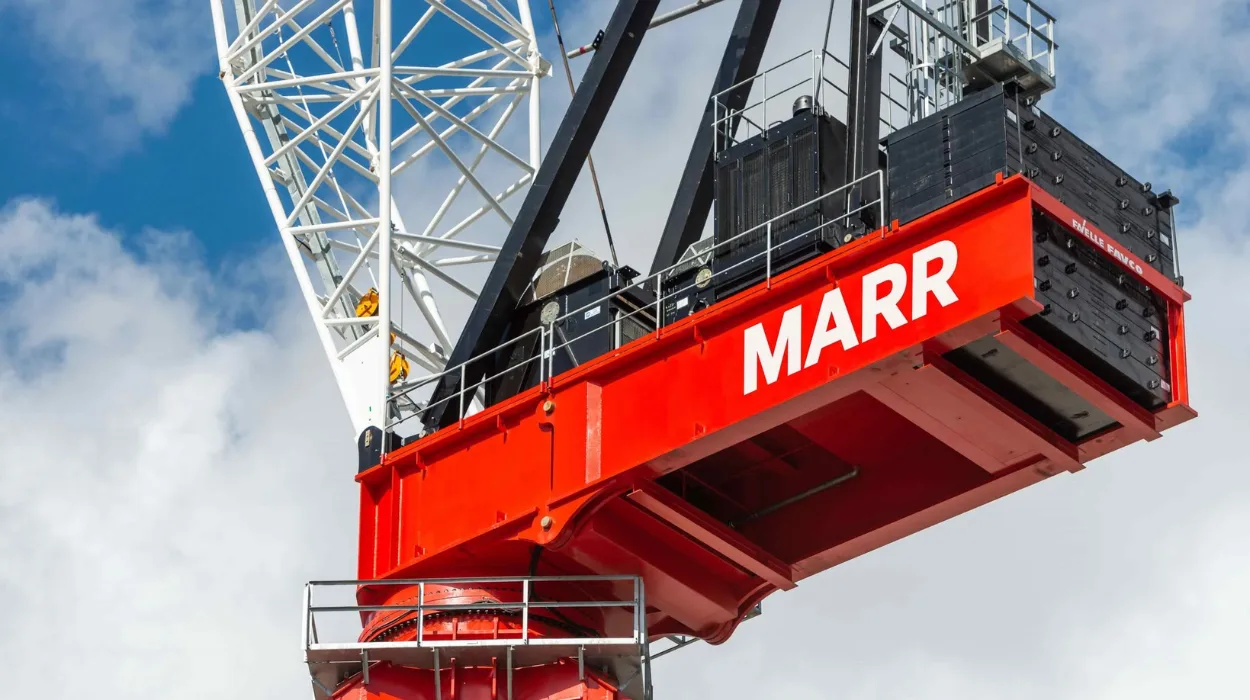
- Lifting Execution: Over a two-month span, one of Marr’s heavy-lift M2480D luffing tower cranes progressively hoisted multiple sections—weighing up to 60 tonnes each—to construct the 100m+ flue gas stack.
- Innovative Alternative: This modularisation strategy and heavy-lift crane setup provided a streamlined alternative to deploying traditional large crawler or mobile cranes.
- Site Constraints Met: Situated on a relatively compact and heavily congested urban location, the primary engineering obstacle was formulating a cranage solution capable of high-volume and heavy lifting without worsening site congestion.
- Strategic Crane Configuration: Marr’s engineering approach utilized two M2480D cranes positioned directly within the plant’s footprint: one on a modular rail system (MTS) inside the waste bunker, and a second on a steel cruciform base with piled foundations at the opposite end of the site.
London (Extra London News) September 2, 2026 — Heavy-lift engineering specialist Marr Contracting has achieved a major construction milestone by completing the installation of a modularised chimney stack scaling over 100 metres in height at the extensive North London Heat and Power Project (NLHPP). Valued at an estimated £1.5bn, the high-profile infrastructure undertaking is spearheaded by the North London Waste Authority (NLWA) with the fundamental goal of replacing an outdated, decades-old energy-from-waste plant situated on a 16-hectare plot at the Edmonton EcoPark. The comprehensive initiative directly serves roughly two million residents distributed throughout seven key north London boroughs, namely Barnet, Camden, Enfield, Hackney, Haringey, Islington, and Waltham Forest, making it one of the region’s most vital modern environmental and civic engineering undertakings.
What is the scope of the North London Heat and Power Project?
The £1.5bn North London Heat and Power Project (NLHPP) represents a monumental transition in municipal waste management and regional power generation. Commissioned by the North London Waste Authority (NLWA), the project is engineered to succeed an aging, legacy energy-from-waste facility that has operated far beyond its original operational lifespan at the Edmonton EcoPark site in north London.
By utilizing advanced technologies, the new energy recovery infrastructure aims to deliver sustainable waste disposal solutions for approximately two million citizens residing across the boroughs of Barnet, Camden, Enfield, Hackney, Haringey, Islington, and Waltham Forest. The complex nature of upgrading a vital municipal asset within a densely populated metropolitan area requires innovative engineering, careful logistical planning, and tight coordination among civil, mechanical, and specialist subcontracting teams.
Explore more London Local News:
State School Childcare Saved in London, 2026
Hackney Council Appoints Wates to Complete Britannia Masterplan in London 2026
How did Marr Contracting execute the 100m flue gas stack installation?
The physical execution of the towering structural milestone required meticulous scheduling and advanced heavy-lift engineering capabilities. Over a tightly managed two-month operational window, heavy-lift specialists deployed one of Marr’s flagship M2480D heavy lift luffing tower cranes. This machine systematically and progressively hoisted multiple modular sections—each weighing up to a staggering 60 tonnes—to construct the complex flue gas stack stretching in excess of 100 metres into the air.
According to reporting details, this modern modular installation approach served as a highly efficient alternative to the conventional deployment of bulky crawler cranes or large mobile cranes, which typically require vast operating radii and extensive temporary ground preparation.
What were the primary engineering challenges on site?
Constructing massive industrial components within a confined environment always introduces critical logistical hurdles. As detailed by the firm, the primary challenge centred on the location itself: a relatively compact and already congested industrial footprint.
Engineering teams needed to design a comprehensive cranage solution capable of safely executing the heavy-load, high-volume lifting demands essential for building the modern plant, all while avoiding the introduction of additional operational complexity or worsening on-site spatial congestion.
As highlighted by the firm regarding the site dynamics, the project required a layout that could maintain continuous productivity without locking up valuable laydown space.
What was Marr Contracting’s technical cranage solution?
To overcome the spatial constraints of the Edmonton EcoPark, Marr developed a bespoke configuration leveraging two high-capacity M2480D tower cranes positioned directly within the operational footprint of the plant.
The first heavy-lift unit was erected using Marr’s proprietary modular rail system (MTS) situated right inside the facility’s waste refuge bunker. Meanwhile, the second crane was successfully installed on a sturdy steel cruciform base supported by deep piled foundations located at the opposite end of the development site.
This dual-unit arrangement provided expansive, overlapping coverage across the entire project footprint, ensuring maximum hook availability, streamlined component placement, and safe vertical transport of heavy materials throughout the ongoing construction timeline.