Key Points
- Major Transformation: After a £25 million investment and a year-long closure, one of London’s oldest and largest public squares has been completely redesigned.
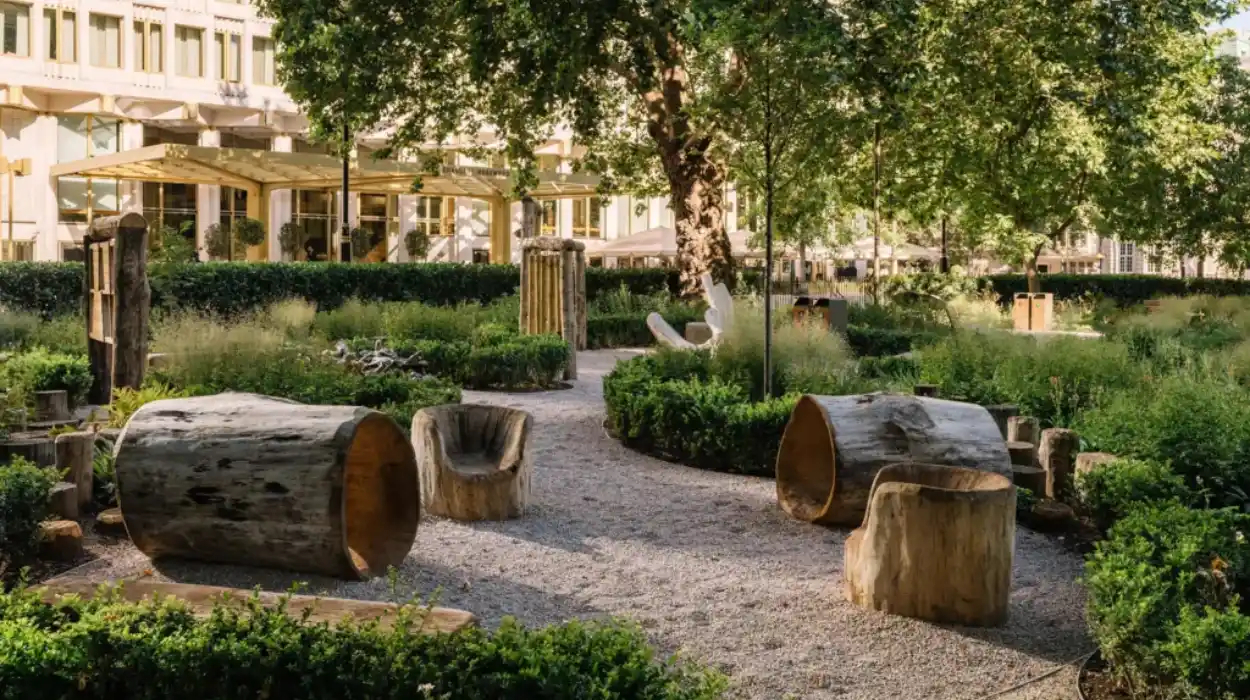
- Biodiversity Boost: Planting has increased from less than 1% to nearly 50% of the square’s area, featuring 150,000 new plants and bulbs across 63 species, 44 new trees, and two new wetland areas.
- Climate Resilience: The project includes soil decompaction across 15,000 square metres, allowing the square to absorb up to 1.4 million litres of stormwater to combat urban flooding.
- Community Amenities: The revitalised space now features 300 additional seats, a new café kiosk, public toilets, and the “Wheatsheaf Building,” an education hub managed by the London Wildlife Trust.
- Historic Reimagining: This is only the fourth redesign in the square’s 300-year history, with the new layout paying homage to the original 1720s oval-shaped lawn design.
London (Extra London News) July 18, 2026 – After a decade of planning and a year of intensive construction, the historic Grosvenor Square in Mayfair is set to reopen its gates to the public on Monday, 20 July, following a transformative £25 million “climate-resilient” overhaul. The project, described by property giant Grosvenor as the most significant private investment in West End public green space in a generation, marks a radical departure from the square’s former state of simple manicured lawns and tarmac paths.
How has the transformation addressed urban climate challenges?
The redesign serves as a direct response to the increasing environmental pressures facing central London, including rising urban temperatures and the threat of flash flooding. According to a report by Katie Forge of Secret London, the project involved extensive soil decompaction across 15,000 square metres—an area equivalent to two football pitches—which now enables the site to capture up to 1.4 million litres of stormwater.
This engineering feat is complemented by a massive increase in flora. As noted by Eloise Feilden in Time Out, the total area dedicated to planting has surged from less than 1% to nearly 50% of the square. This includes the introduction of 70,000 plants, 80,000 bulbs, and 44 new trees, all selected for their ability to withstand warmer summers and wetter winters while providing essential cooling effects and habitats for urban wildlife.
What is the history and design philosophy behind the new square?
Despite the modern environmental focus, the redesign remains deeply rooted in the square’s 300-year heritage. As highlighted by BusinessGreen, the project was the fourth major redesign in the site’s history. The current layout, led by London-based architecture practice Tonkin Liu and delivered by BDP, reinstates the original oval-shaped lawn that featured in the 1720s design.
The late Professor Nigel Dunnett, a celebrated horticulturalist who passed away in April 2026, spearheaded the planting strategy. His work at the square stands as one of his final completed projects, reflecting his lifelong philosophy that urban landscapes must serve both the people who use them and the natural world.
Explore more Local London News:
Teenager Charged After Car Crash on Devas Street, Tower Hamlets, 2026
Six Arrested Following Home Office Immigration Raid on Evri, Croydon, 2026
What does this mean for the local community and visitors?
The revitalisation extends beyond aesthetics and ecology to include new public infrastructure designed to encourage year-round use. The London Wildlife Trust confirmed that the square now hosts a new visitor and learning hub, the “Wheatsheaf Building,” which will offer free school visits, family activities, and workshops to help the public engage with nature.
Furthermore, the space has been made more accessible and comfortable with 300 additional seats, public toilets, water fountains, and a new café kiosk serving refreshments. Existing memorials, including those dedicated to Franklin D. Roosevelt, the Eagle Squadrons, and the victims of 9/11, have been carefully integrated into the new landscape to ensure the square’s historical significance is preserved.
What have the key stakeholders said about the project?
The project has garnered significant support from city leaders and those involved in its delivery. Speaking on the importance of the revitalisation, James Raynor, CEO of Grosvenor Property UK, stated that the square would become
“one of the world’s most outstanding and innovative urban green spaces, responding to the climate emergency whilst inspiring joy, delight and wonder”.
The Mayor of London, Sadiq Khan, welcomed the reopening as a positive step for the capital. As reported by BusinessGreen, the Mayor remarked:
“It’s amazing to see Grosvenor Square revitalised with dozens of new plant species and wildlife, providing a space where both Londoners and visitors can reconnect with nature. This extraordinary urban garden showcases how investment in our public spaces can help to build a greener, fairer and better city for everyone”.
Reflecting on the emotional and environmental impact of the site, Jamie Whitty-Lewis, chief executive of Grosvenor Property UK, previously commented on the cooling effect of the new vegetation, noting: “We’ve truly revitalised it into a really special garden now. The planting here has a cooling effect, so you’ll feel right now it’s actually quite cool here under the shade of the trees”.
The Duke of Westminster also expressed his pride in the project, stating:
“The reopening of Grosvenor Square is a very special moment for Grosvenor and for this part of London. The Square has been at the heart of Mayfair for three hundred years, and our responsibility has been to respect that history while ensuring it is ready to serve London for the next century”.
How will the space function moving forward?
With the opening of the gates on Monday, the square is expected to transition into a centre for community engagement. The London Wildlife Trust has outlined a full programme of events, ranging from “Nature Storytime” for young children to “Wonderful Wildlife Weekends” for families.
The project serves as a model for private-public collaboration in urban planning. By successfully balancing biodiversity net gain with human-centric amenities, Grosvenor aims to demonstrate that historic urban spaces can be effectively adapted to meet the environmental and social challenges of the 21st century. As the plants mature over the coming seasons, the landscape is expected to become increasingly rich and diverse, cementing its new status as a vital “biodiverse haven” in the heart of London.