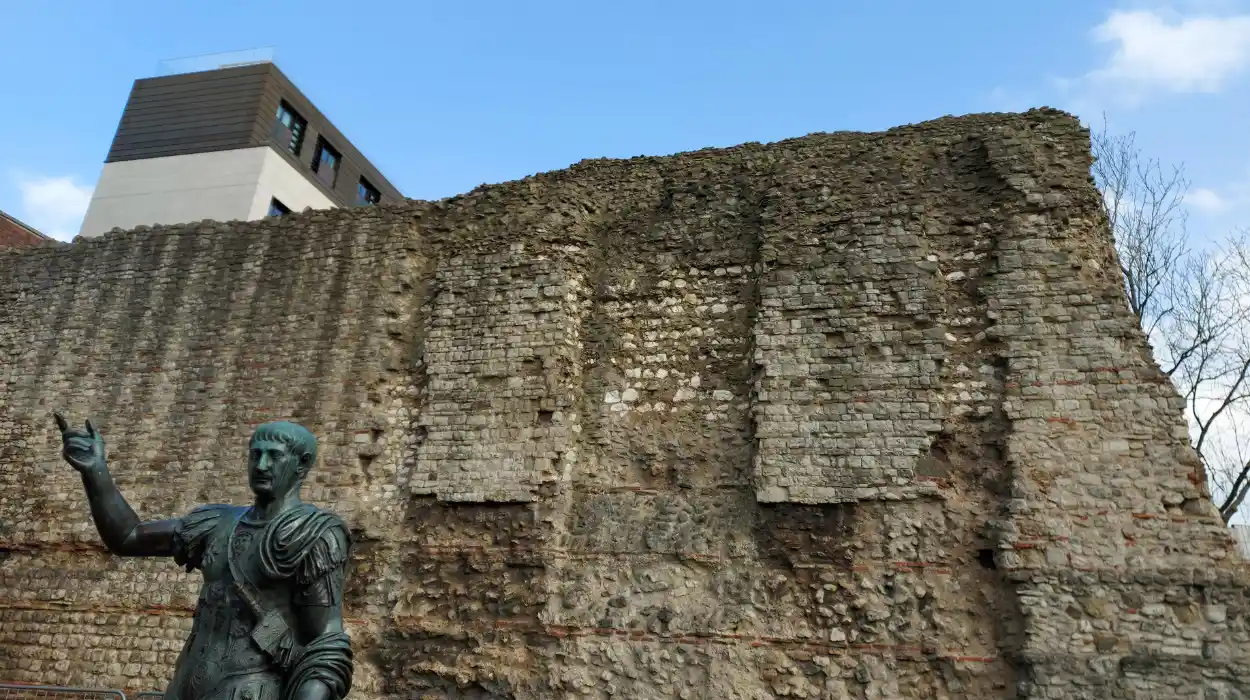
The Roman London Wall remains one of the most important surviving structures from ancient Britain. Built nearly two thousand years ago, the wall defined the boundaries of Roman Londinium, protected administrative and commercial districts, and influenced the development of London long after the Roman Empire withdrew from Britain. Significant fragments still survive throughout the City of London, embedded between office towers, medieval churches, gardens, and transport routes.
- Why did the Romans build the London Wall?
- Where can visitors see the Roman London Wall today?
- How did the Roman Wall influence medieval London?
- What archaeological discoveries revealed about Roman London?
- What was daily life like inside Roman Londinium?
- Why are the surviving wall fragments historically important today?
- How can visitors experience A Self-Guided Walking Tour of Roman London’s Ruins?
Today, visitors can walk alongside original Roman masonry, examine defensive bastions, and follow the same perimeter that shaped London’s geography for centuries. The surviving remains provide direct evidence of Roman engineering, military planning, and urban administration in Britain.
Why did the Romans build the London Wall?
The Roman London Wall was constructed between AD 190 and AD 225 to defend Londinium, reinforce Roman political authority, and regulate commercial movement across Roman Britain. The wall enclosed approximately 330 acres and transformed Londinium into a fortified provincial capital with controlled entry points and military infrastructure.
Roman Londinium was established shortly after the Roman invasion of Britain in AD 43 under Emperor Claudius. The settlement grew rapidly because of its strategic position beside the River Thames. The river created direct trade access to continental Europe while also providing an important crossing point within southeastern Britain.
By the late second century, Londinium had become the administrative capital of Roman Britain. The city contained government buildings, warehouses, temples, bathhouses, markets, and residential districts. Economic growth increased the city’s importance within the Roman Empire’s northwestern provinces.
The Roman government began constructing large defensive walls across important cities during the late second and early third centuries. Political instability, frontier conflicts, and increased raiding activity threatened imperial security. Roman authorities strengthened urban centres to protect trade routes and administrative systems.
The London Wall stretched for approximately 2 miles, or 3.2 kilometres, around the city. Archaeological research indicates that the wall stood nearly 6 metres high and measured approximately 2.5 metres thick in several sections. Builders used Kentish ragstone transported from quarries in southeastern England. Red Roman tiles formed bonding layers between stone courses to improve stability.
The wall included multiple defensive gates controlling access into Londinium. Major gates included:
- Aldgate in the east
- Bishopsgate in the northeast
- Cripplegate in the north
- Newgate in the west
- Ludgate in the southwest
Many modern London street names preserve these Roman gate locations. The wall also included towers and bastions that allowed soldiers to monitor surrounding areas and defend vulnerable sections.
Roman engineers carefully aligned the fortification with the city’s street network and commercial districts. The wall enclosed major civic buildings, including the forum, basilica, amphitheatre, and military installations.
The construction of the wall permanently shaped London’s urban geography. Medieval and later city development followed the same defensive perimeter for centuries.
Where can visitors see the Roman London Wall today?
Large sections of the Roman London Wall survive at Tower Hill, Noble Street, the Barbican, Cooper’s Row, and surrounding areas within the City of London. These preserved remains include original Roman masonry, medieval repairs, defensive bastions, and archaeological interpretation panels accessible throughout the year.
Modern visitors can still observe substantial sections of the original Roman fortification integrated into London’s contemporary urban landscape. Preservation efforts during the twentieth century protected many fragments discovered during postwar reconstruction projects.
Tower Hill
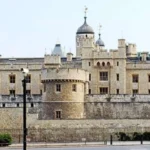
One of the most impressive surviving sections stands near the Tower of London at Tower Hill. This fragment preserves both Roman and medieval construction phases. Visitors can clearly identify Roman ragstone and tile bonding courses beneath later medieval additions.
The Tower Hill section includes one of the late Roman bastions added during the fourth century. Bastions projected outward from the wall and improved defensive visibility. Roman soldiers used these structures to strengthen protection against attacks and raids.
The surrounding public walkway allows close examination of Roman construction methods. Information panels explain the chronology of repairs and modifications spanning more than a thousand years.
Noble Street
Noble Street contains another major surviving section beside modern office developments. Archaeologists uncovered extensive remains here after bombing during the Second World War exposed buried foundations.
The Noble Street fragment includes one of the best-preserved Roman bastions in London. The structure demonstrates how Roman military engineers reinforced vulnerable northern sections of the city wall during periods of instability.
Excavations revealed that medieval and Victorian buildings were constructed directly above Roman foundations. This continuity preserved large sections beneath later urban layers.
Barbican Estate
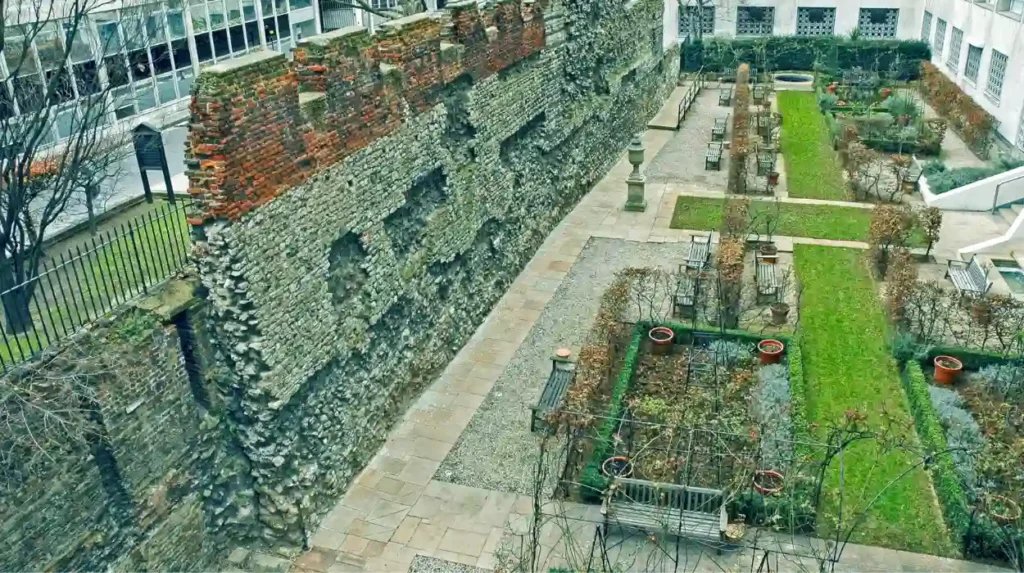
The Barbican Centre area contains several visible fragments integrated into landscaped public spaces and residential developments.
Postwar planners intentionally preserved archaeological remains uncovered during reconstruction. Roman masonry now stands beside elevated walkways, gardens, and residential towers.
The Barbican district originally formed the northwestern perimeter of Roman Londinium. Excavations uncovered roads, pottery, coins, and domestic artefacts associated with Roman occupation.
Cooper’s Row and Trinity Square
Smaller surviving fragments stand near Cooper’s Row and Trinity Square Gardens. These sections preserve Roman foundations together with medieval rebuilding phases.
The surrounding area historically connected Londinium to commercial riverfront activity along the Thames. Archaeologists discovered imported ceramics, warehouse remains, and trade infrastructure linked to Roman maritime commerce.
Museum of London Area
The former Museum of London complex near London Wall historically served as a major centre for interpreting Roman London archaeology. Although the museum is relocating to West Smithfield, the surrounding district still contains preserved Roman remains visible within the streetscape.
To experience this historic landmark in person today, consult our comprehensive [Insert Anchor Text for Things to Do Article Here] for itineraries and visiting parameters.
How did the Roman Wall influence medieval London?
The Roman Wall shaped medieval London’s administration, trade regulation, defensive planning, and street network for more than one thousand years after Roman rule ended. Medieval authorities repaired Roman fortifications, reused gates, and preserved the ancient boundary as a central part of urban governance.
Following the collapse of Roman administration in the early fifth century, Londinium experienced economic decline and population reduction. However, the physical structure of the wall remained dominant within the landscape.
During the late ninth century, King Alfred the Great restored London’s defences to resist Viking attacks. Anglo-Saxon authorities repaired sections of the Roman wall and reoccupied the enclosed city.
The Roman fortifications continued functioning as London’s primary defensive system throughout the medieval period. Gates controlled movement into the city and became important centres for taxation, trade regulation, and civic administration.
Medieval London developed around the Roman boundary. Markets, churches, guild halls, and administrative institutions were concentrated within the walled area. Expansion outside the wall increased gradually between the twelfth and sixteenth centuries, but the ancient perimeter retained symbolic and legal importance.
Several modern London districts preserve names derived from Roman gates:
- Aldgate
- Bishopsgate
- Cripplegate
- Ludgate
These names demonstrate the lasting influence of Roman infrastructure on London’s geography and identity.
The wall also shaped transportation routes. Modern roads frequently follow ancient alignments established during the Roman period. Parts of the present-day street called London Wall trace the northern defensive boundary almost exactly.
By the eighteenth century, London’s population growth created severe traffic congestion around the medieval gates. Authorities demolished most gate structures to improve movement through the city. However, large buried sections of wall survived beneath expanding urban development.
What archaeological discoveries revealed about Roman London?
Modern archaeological excavations uncovered extensive evidence of Roman Londinium, including roads, amphitheatres, bathhouses, warehouses, temples, coins, inscriptions, and defensive bastions. These discoveries transformed the understanding of Roman Britain and revealed Londinium’s importance within imperial trade and administration.
The most important archaeological investigations occurred during the twentieth century. Bombing during the Second World War destroyed large sections of the City of London and exposed buried Roman foundations beneath damaged buildings.
Reconstruction projects allowed archaeologists to conduct extensive excavations across previously inaccessible areas. Researchers uncovered significant sections of the Roman wall together with associated infrastructure.
Major discoveries included:
- The Roman amphitheatre beneath Guildhall Yard
- Defensive bastions along the northern sections
- Roman cemeteries outside city limits
- Commercial warehouses near the Thames
- Mosaic floors and hypocaust heating systems
- Religious structures, including the Temple of Mithras
Archaeologists recovered imported goods demonstrating Londinium’s international trade connections. Artefacts included:
- Spanish olive oil amphorae
- North African pottery
- German ceramics
- Continental glassware
Coins and inscriptions helped researchers establish accurate construction dates and identify phases of military reinforcement.
Excavations also revealed advanced Roman engineering methods. Builders used deep foundations and layered construction techniques to stabilise the wall across difficult terrain near the Thames floodplain.
Modern archaeological methods, including laser scanning, digital mapping, and 3D modelling, continue to improve understanding of Roman London’s infrastructure and urban planning.
What was daily life like inside Roman Londinium?
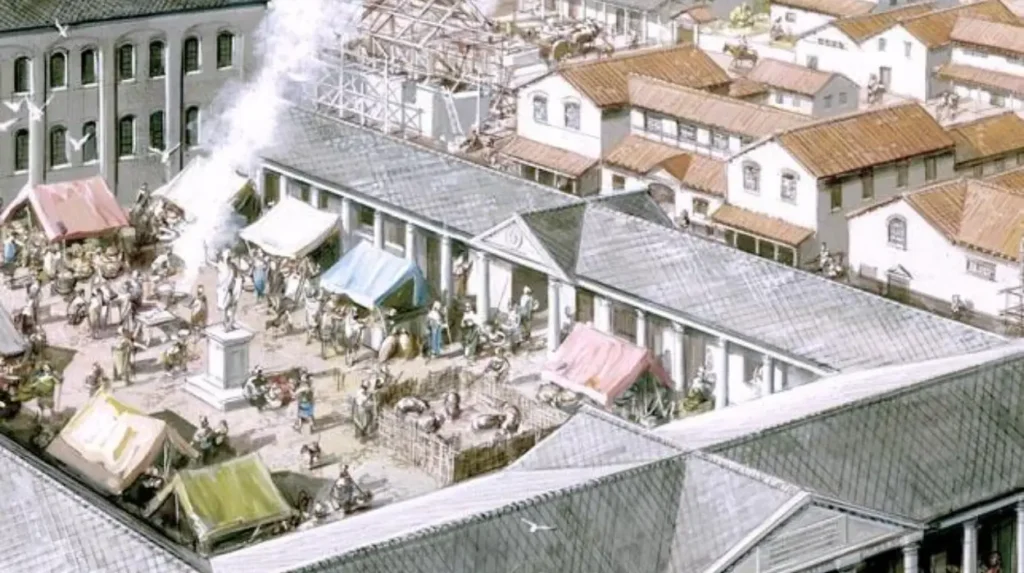
Daily life inside Roman Londinium centred on commerce, administration, religion, and military organisation. Residents lived within a densely populated urban environment containing markets, bathhouses, temples, workshops, paved roads, and international trade networks connected to the wider Roman Empire.
Londinium became one of the largest settlements in Roman Britain. Historians estimate that the population reached between 30,000 and 45,000 residents during the second century.
The city contained diverse social groups, including:
- Roman officials
- Soldiers
- Merchants
- Craftspeople
- Labourers
- Enslaved individuals
The Roman Forum and basilica formed the centre of political and economic activity. Archaeological evidence indicates that the forum complex ranked among the largest public buildings north of the Alps.
Public bathhouses provided hygiene facilities and social gathering spaces. Taverns and shops lined major streets throughout the city.
Religion played an important role in urban life. Temples dedicated to Roman gods stood alongside shrines reflecting local British traditions and eastern mystery cults. The Temple of Mithras demonstrated the cultural diversity present within Roman London.
Trade dominated the city’s economy. Ships transported goods through the Thames from continental Europe and other parts of the Roman Empire. Imported products included wine, olive oil, jewellery, ceramics, and luxury materials.
Roman engineering improved living standards through:
- Paved roads
- Drainage systems
- Public water supply
- Heated buildings using hypocaust technology
The wall itself shaped everyday experience. Gates regulated movement, and military patrols monitored activity around entrances.
Why are the surviving wall fragments historically important today?
The surviving Roman Wall fragments provide direct physical evidence of London’s origins, urban continuity, and archaeological development. The remains preserve ancient engineering techniques while supporting education, tourism, conservation research, and public understanding of Roman Britain’s history.
The Roman Wall represents one of the oldest surviving structures in central London. Few major cities preserve defensive infrastructure reused continuously for nearly two millennia.
The remains demonstrate continuity between Roman Londinium and modern London. Medieval, Victorian, and contemporary builders repeatedly incorporated Roman foundations into newer structures.
The wall also preserves evidence from multiple historical periods. Roman masonry supports medieval repairs and later adaptations reflecting changing military and political conditions.
Heritage organisations, including Historic England and the City of London Corporation, manage conservation programmes protecting surviving fragments from development pressures.
Educational institutions use the wall to study:
- Roman engineering
- Urban archaeology
- Heritage preservation
- Medieval reuse of classical infrastructure
The site also supports cultural tourism and historical education. Visitors encounter physical evidence of London’s ancient origins while moving through a modern financial district.
Digital preservation projects increasingly use geographic information systems and 3D reconstruction technologies to document surviving remains and buried sections.
How can visitors experience A Self-Guided Walking Tour of Roman London’s Ruins?
A Self-Guided Walking Tour of Roman London’s Ruins allows visitors to follow the ancient defensive perimeter through preserved wall fragments, archaeological landmarks, museums, churches, and historic streets across the City of London. The route connects Roman, medieval, and modern London within a single urban landscape.
The walking route typically begins near the Tower of London at Tower Hill, where one of the largest surviving wall sections remains visible beside the modern street.
From Tower Hill, visitors can follow the approximate Roman perimeter westward through the City of London. Interpretive signs and preserved ruins explain construction methods, excavation history, and medieval modifications.
Important stops along A Self-Guided Walking Tour of Roman London’s Ruins include:
- Tower Hill
- St Alphage Garden
- Guildhall
- Temple of Mithras
- Barbican Centre
The route demonstrates how modern skyscrapers stand directly above Roman foundations. Visitors can observe nearly two thousand years of continuous urban development concentrated within a compact geographic area.
Many surviving fragments remain accessible without admission charges. Public gardens, walkways, and open plazas provide close views of Roman masonry integrated into contemporary architecture.
A Self-Guided Walking Tour of Roman London’s Ruins also reveals the influence of Roman planning on modern street alignments. Roads, including the London Wall, preserve the ancient defensive route with remarkable accuracy.
Several churches and medieval structures near the wall incorporate Roman materials reused during later construction phases. Archaeologists identified Roman stone and tile fragments embedded within medieval foundations throughout the City of London.
Modern conservation programmes continue protecting surviving sections while allowing public access. Urban planners increasingly integrate archaeological preservation into redevelopment projects across central London.
The Roman wall remains one of the clearest physical links between modern London and its ancient origins. Its survival within one of the world’s leading financial centres demonstrates the endurance of Roman engineering and the long historical continuity of urban London.
What was the Roman London Wall?
The Roman London Wall was a defensive stone fortification built around the city of Londinium between AD 190 and AD 225. It enclosed approximately 330 acres and protected the administrative, military, and commercial centre of Roman Britain.