Key Points
- Political Divergence: First Minister John Swinney has drawn a sharp distinction between the “calm and elegance” of Holyrood and the “utter chaos” currently engulfing Westminster.
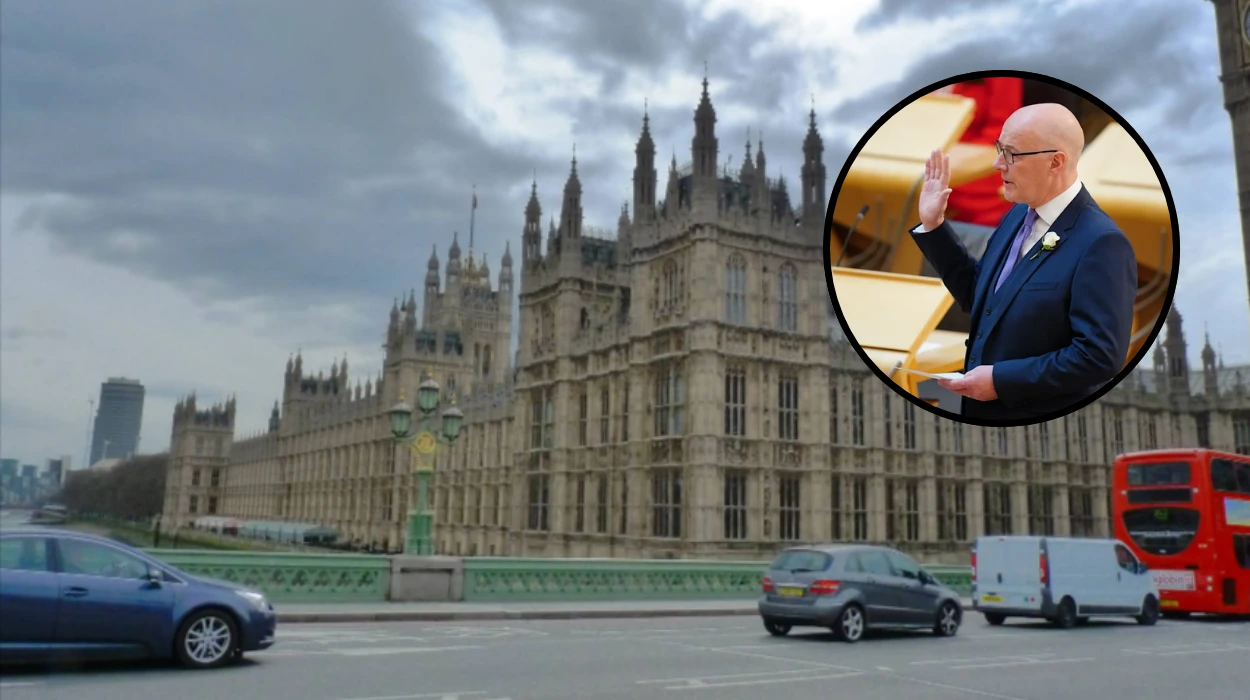
- Personal Milestone: Swinney expressed “enormous pride” as the first Member of the Scottish Parliament (MSP) to be sworn in specifically as the leader of the largest party.
- Labour in Crisis: The comments come as Prime Minister Sir Keir Starmer faces a massive internal revolt, with over 80 Labour MPs demanding his resignation.
- Government Instability: Four ministers have resigned from the UK Cabinet, and reports indicate Health Secretary Wes Streeting may be preparing a leadership challenge.
- Institutional Comparison: The First Minister framed the Scottish Parliament as a stable, functional institution in direct opposition to the perceived breakdown of governance in London.
Edinburgh (Extra London News) May 14, 2026 – First Minister John Swinney has launched a scathing critique of the political turmoil currently paralyzing the UK Government, contrasting the “utter chaos” of Westminster with what he described as the “calm and elegance” of the Scottish Parliament. Speaking from Holyrood, Mr Swinney reflected on his tenure and the stability of Scottish institutions as Prime Minister Sir Keir Starmer faces an unprecedented mutiny within the Labour Party. With more than 80 MPs calling for the Prime Minister’s departure and a string of high-profile ministerial resignations, the First Minister argued that the devolved administration in Edinburgh offers a blueprint for functional governance that the London executive has failed to maintain.
- Key Points
- Why did John Swinney compare Holyrood to Westminster?
- What is the current extent of the rebellion against Sir Keir Starmer?
- Is Wes Streeting planning a leadership challenge?
- How does John Swinney view his role as First Minister?
- What are the implications of the “Westminster chaos” for Scotland?
- How have Westminster figures responded to Swinney’s remarks?
- Summary of the Political Climate
Why did John Swinney compare Holyrood to Westminster?
As reported by David Wallace of The Edinburgh Gazette, John Swinney used a scheduled address to highlight the widening gap between the political cultures of Scotland and the wider UK.
Swinney’s remarks were not merely observational but served as a strategic positioning of the Scottish National Party (SNP) as a steady hand during a period of British constitutional fragility.
According to political correspondent Fiona Miller of The Herald, Swinney stated that:
“The contrast between the two legislatures has never been more acute. While we see the utter chaos and the breakdown of discipline in Westminster, Holyrood remains a place of calm and elegance, focused on the delivery of public services for the people of Scotland.”
Swinney’s rhetoric suggests that the institutional design of the Scottish Parliament—intended to be more consensual than the adversarial “Westminster model”—has finally proven its worth during a time of national crisis.
What is the current extent of the rebellion against Sir Keir Starmer?
The backdrop to Mr Swinney’s comments is a Westminster environment that many veteran observers describe as “toxic.” Writing for The Guardian, political editor Pippa Crerar noted that the Prime Minister’s authority has effectively “evaporated” following a disastrous week of internal polling and policy U-turns.
As reported by BBC News political correspondent Chris Mason, the number of Labour MPs publicly calling for Sir Keir Starmer to resign has now exceeded 80. This faction, which includes both backbenchers and former frontbench loyalists, argues that the Prime Minister’s “project” has stalled. Furthermore, four ministers—whose names have been cited by The Independent as key figures in the moderate wing of the party—have officially tendered their resignations, citing a “lack of direction and loss of public trust.”
Is Wes Streeting planning a leadership challenge?
Perhaps the most damaging development for the Prime Minister is the emergence of a potential successor from within his own Cabinet.
According to an exclusive report by Steven Swinford of The Times, Health Secretary Wes Streeting is widely believed to be “mounting a leadership challenge” to replace Starmer.
The report by Swinford indicates that Streeting has been “sounding out donors and securing the support of key parliamentary figures” over the last 48 hours.
While Mr Streeting has not officially declared his candidacy, his silence regarding the Prime Minister’s future has been interpreted by Westminster insiders as a calculated move. As stated by Sky News Chief Political Correspondent Jon Craig:
“The silence from the Health Secretary’s camp is deafening. In the corridors of Westminster, it isn’t a question of ‘if’ Mr Streeting will move, but ‘when’.”
How does John Swinney view his role as First Minister?
Amidst the volatility in London, John Swinney took a moment to reflect on his own constitutional position. Having served in the Scottish Parliament since its inception in 1999, his recent ascension to the leadership represents a significant personal and professional milestone.
As reported by The Scotsman’s political team, Mr Swinney stated that he felt “enormous pride” to be the first MSP to be sworn in as the leader of the largest party at Holyrood under the current parliamentary configuration.
He emphasised that his focus remains on “legislative discipline,” a trait he claims is currently absent from the UK Cabinet.
Speaking to a gathered press pack outside the chamber, as documented by STV News, Swinney remarked:
“I am here to ensure that Scotland has a government that works. We do not have the luxury of indulging in the kind of internecine warfare that is currently tearing the Labour Party apart in London. My pride in this institution is matched only by my determination to protect it from the fallout of Westminster’s instability.”
What are the implications of the “Westminster chaos” for Scotland?
The First Minister’s comparison is more than just political point-scoring; it touches on the ongoing debate regarding Scottish independence and the efficacy of the Union.
By framing Westminster as “chaotic,” the SNP leader is attempting to revitalise the argument that Scotland would be better served by having full control over its own affairs, free from the “contagion” of London’s political infighting.
Explore More London Politics News
London 2026 Elections: Green Party & Reform UK Borough Wins
Sadiq Khan’s Oxford Street Pedestrian Plan Sparks Westminster Election Fight 2026
Will the Labour rebellion affect the Scottish Labour Party?
The turmoil in London creates a significant headache for Anas Sarwar, the leader of the Scottish Labour Party. As reported by Daily Record political editor Paul Hutcheon, the SNP is already using the Westminster crisis to undermine Scottish Labour’s recent gains in the polls.
Hutcheon noted that
“John Swinney’s comments are designed to pin the failings of the UK Labour leadership onto the local branch in Scotland.”
If Sir Keir Starmer is forced out, it could leave the Scottish Labour Party in a state of limbo, having spent years tying their political identity to Starmer’s “changed Labour” brand.
How have Westminster figures responded to Swinney’s remarks?
Unsurprisingly, the First Minister’s characterisation has met with a frosty reception from some quarters in London. A spokesperson for the Prime Minister, in a statement provided to The Press Association, dismissed Swinney’s comments as “opportunistic.”
The spokesperson stated:
“The First Minister would be better served focusing on the Scottish NHS and the attainment gap in Scottish schools rather than commentating on the internal matters of another political party. The UK Government remains focused on delivering for the whole of the United Kingdom.”
However, even within the Conservative opposition in London, there is an acknowledgment of the severity of the situation. As reported by The Telegraph’s Ben Riley-Smith, one senior Tory MP admitted that the “optics of a functional Holyrood versus a fractured Westminster” are currently “disastrous for the Unionist cause.”
Summary of the Political Climate
The current situation represents a total inversion of the political landscape from only a year ago. Where once the SNP was mired in internal leadership struggles and police investigations, it is now the Labour Party—both in government and in its UK-wide structure—that appears to be crumbling.
- At Holyrood: A First Minister projecting an image of stability, “calm,” and institutional respect.
- At Westminster: A Prime Minister fighting for his political life against 80 rebels, four missing ministers, and a looming challenge from his Health Secretary.
The coming days will be critical. If Wes Streeting or another challenger moves formally against Sir Keir Starmer, the “chaos” John Swinney described will likely intensify, further deepening the rift between the two seats of power in the United Kingdom.
As noted by veteran political analyst Andrew Marr in a recent column for The New Statesman:
“The British state is currently a tale of two parliaments. One is functioning with the rhythmic, if slightly dull, precision of a Swiss watch; the other is a ticking time bomb. Swinney knows this, and he is making sure every voter in Scotland knows it too.”
For now, the “calm and elegance” of Holyrood stands as a stark, deliberate contrast to the feverish atmosphere of the House of Commons—a narrative John Swinney intends to maintain for as long as the crisis in London persists.