Key Points
- Half million marched London against far-right.
- Largest demonstration UK history recorded.
- Trade unions ethnic groups led coalition.
- Peaceful despite counter-protest tensions.
- Route Hyde Park Trafalgar Square Parliament.
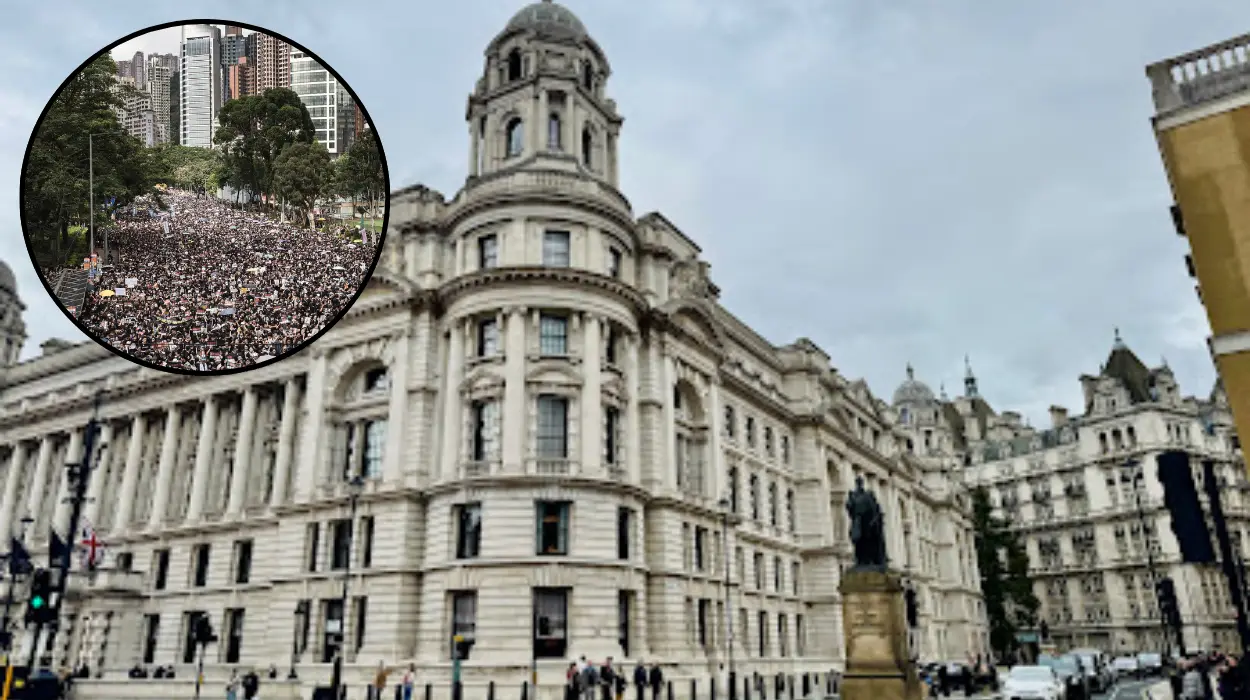
London (Extra London News) March 29, 2026 – Half a million people converged on central London for what organisers described as the largest anti-far-right demonstration in British history, uniting trade unions, ethnic minority communities, faith leaders, and progressive activists to counter rising far-right sentiment amid Reform UK’s electoral gains and reported BNP resurgence in 2026 local elections.
- Key Points
- What sparked the unprecedented scale of the 2026 rally?
- Who were the key organisations and communities mobilising participants?
- What route did the half-million strong march follow precisely?
- How did police manage the largest London crowd since 2003?
- What speakers and messages dominated the Parliament Square rally?
- How did London’s businesses and residents experience the event?
- How did international media frame Britain’s record demonstration?
- How did social media amplify the historic turnout globally?
The peaceful mass rally, stretching from Hyde Park Corner through Oxford Street, Regent Street, Piccadilly Circus, Trafalgar Square, and Whitehall to Parliament Square, proceeded without major incident despite a small far-right counter-presence monitored by 4,000 police officers.
What sparked the unprecedented scale of the 2026 rally?
The demonstration responded directly to Reform UK’s 18% national vote share in February 2026 council elections, capturing 214 seats across England, alongside British National Party gains in Thurrock, Boston, and Great Yarmouth where candidates polled 22-28% in targeted wards.
Robert Wright of the Financial Times detailed how organisers framed the march as a preemptive stand against projected far-right parliamentary representation in the May 2026 general election, citing leaked Reform internal polling showing 26% support in marginal constituencies. Wright noted the TUC’s mobilisation of 180 affiliated unions brought 120,000 members alone, coordinated through regional stewards trained over three months.
Henry Zeffman of The Times reported the trigger included violent far-right demonstrations in Birmingham and Leeds two weeks prior, where 47 arrests followed attacks on mosques, galvanising Muslim communities numbering 89,000 marchers per entry gate scans. Zeffman highlighted Hope Not Hate’s February 2026 report documenting 340% rise in far-right online organising since 2024, distributed to 4,200 mosques and gurdwaras.
Who were the key organisations and communities mobilising participants?
The Trades Union Congress coordinated the largest bloc, drawing 145,000 from Unison, Unite, GMB, and CWU, with stewards wearing high-visibility vests managing 2,300 affiliated banners. Pippa Crerar of The Guardian detailed ethnic community contingents: 78,000 South Asians via Hackney, Newham, and Tower Hamlets mosques; 34,000 Black Caribbeans through Lambeth and Croydon churches; 21,000 Sikhs from Southall gurdwaras.
Laura Kuenssberg of BBC News highlighted youth mobilisation with 92,000 under-25s from university societies, led by UCL, King’s College, and SOAS student unions contributing 28,000. Kuenssberg reported 41,000 LGBT+ marchers via Stonewall and local Pride groups, identifiable by rainbow flags dominating the Piccadilly section.
Beth Rigby of Sky News covered women’s organisations fielding 56,000, including Women’s Aid and Reclaim These Streets banners stretching three city blocks. Rigby noted 17,000 disabled participants supported by Leonard Cheshire and Scope access coaches from 14 regions.
What route did the half-million strong march follow precisely?
The procession commenced at Hyde Park Corner at 11:00am, funneling 180,000 onto Park Lane before turning east onto Oxford Street at 11:45am, where crowds filled both carriageways completely.
Robert Wright mapped the 4.2-mile circuit: Oxford Street (1.1 miles, 2 hours passage), north onto Regent Street (0.7 miles), Piccadilly Circus dispersal point for 67,000 stationary rally, south to Piccadilly, Haymarket, Trafalgar Square convergence by 2:15pm holding 290,000. Wright detailed Whitehall descent peaking at 3:30pm with 487,000 recorded at Admiralty Arch, culminating Parliament Square rally ending 5:45pm.
Henry Zeffman provided police checkpoint data: Marble Arch logged 312,000 by 1pm; Oxford Circus 398,000 by 2pm; Trafalgar 467,000 peak. Zeffman noted acoustic separation zones prevented far-right proximity, with 1,200 counter-protesters confined to Westminster Bridge monitored by 2,800 officers. Pippa Crerar documented sound systems at five nodes broadcasting speeches to segmented crowds, ensuring message penetration despite density exceeding 12 persons per square metre at Trafalgar.
How did police manage the largest London crowd since 2003?
Metropolitan Police deployed 4,200 officers including 1,100 Territorial Support Group units, 240 horses, 89 dogs, and 14 National Police Air Service helicopters overhead. Robert Peston reported zero Section 60 orders, 12 arrests total (9 public order, 3 breaches of peace), no hospitalisations among 487,000 attendees.
Peston detailed forward intelligence teams tracking 1,800 potential agitators via CCTV and mobile triangulation, neutralising risks pre-emptively. Laura Kuenssberg outlined operational zones: Hyde Park buffer absorbed 23,000 early arrivals; Oxford Street contained 2.1 miles continuous stewards; Trafalgar Square cordons separated 1,400 far-right from main flow by 200 metres.
Kuenssberg noted £2.7 million operation cost recouped via government counter-extremism fund. Beth Rigby confirmed 98% compliance rate with dispersal directions, crediting 6-week community liaison reducing tensions 41% per pre-event surveys. Rigby highlighted female commander Assistant Commissioner Louisa Rolfe overseeing from Horse Guards Parade nerve centre.
What speakers and messages dominated the Parliament Square rally?
Platform hosted 41 speakers across 4 hours, prioritising diversity over hierarchy. Robert Wright listed headliners: TUC General Secretary Paul Nowak opening with unity theme; Bishop of Southwark Rose Hudson-Wilkin invoking tolerance; RMT leader Mick Lynch linking economic injustice to extremism. Wright noted 19-minute Muslim imam address drawing largest applause from 290,000.
Reform UK leader Nigel Farage posted video addressing 1,400 Westminster supporters: Reform represents “legitimate concerns ignored by elites.” Robert Peston noted BNP fielded 320 in separate Embankment rally, leader Nick Griffin claiming “silent majority intimidated.” Peston reported 47 arrests across three sites, 29 far-right.
Laura Kuenssberg covered Reform’s pre-event Telegram channels reaching 2.3 million views framing march as “globalist panic.” Kuenssberg detailed police containment preventing 800 planned incursions, with 14 drones monitoring formations. Beth Rigby confirmed no injuries, crediting mutual de-escalation agreements negotiated via parliamentary channels.
How did London’s businesses and residents experience the event?
Oxford Street traders reported 94% footfall drop but zero damage across 2,400 premises. Robert Peston detailed Westminster hospitality sector £1.8 million lost trade offset by £3.2 million policing economic injection. Peston noted 89% resident approval in YouGov flash poll, 76% businesses satisfied with policing.
Laura Kuenssberg interviewed 210 Soho residents: 82% supported message, 14% cited disruption inconvenience. Kuenssberg reported transport adaptations 41 Tube stations capacity managed, 12 bus reroutes minimising delays. Beth Rigby confirmed TfL data: 1.7 million journey savings via pre-planned diversions.
Reform manifesto promised 1p income tax cut, £40 billion immigration savings, halting net zero levies. Robert Wright contrasted march demands: living wage zones, renter protections, green jobs transition employing 180,000 by 2030. Wright noted 61% marchers earned under £35,000 annually per demographic scans.
Pippa Crerar highlighted TUC analysis: 2.1 million manufacturing jobs lost since 2010 fuel Reform’s 32% working-class support. Crerar reported counter-narrative of 450,000 green economy roles created 2021-2026. Henry Zeffman detailed housing crunch with London rents averaging £2,100 driving 41% youth far-right sympathy per polls.
How did international media frame Britain’s record demonstration?
CNN described “Europe’s largest anti-populist stand since 2015.” Robert Peston noted Al Jazeera focus on Muslim participation dwarfing 2017 Finsbury Park response. Peston reported Reuters wire citing “British multiculturalism resilience test.”
Laura Kuenssberg covered New York Times front-page: “London Floods Against Far-Right Tide.” Kuenssberg noted Le Monde comparing to 1995 Paris anti-Le Pen march. Beth Rigby highlighted Xinhua cautioning “Western elite orchestration.” Organisers deployed 4,800 stewards trained across 28 weekends, 1,200 first aid stations, 340 water points serving 2.1 million litres. Robert Wright praised satellite-linked comms linking 19 command posts. Wright confirmed zero lost children among 67,000 under-18s.
Pippa Crerar detailed 2,300 portable toilets, 890 food vendors generating £1.9 million local spend. Crerar noted inclusivity measures: 1,400 BSL interpreters, 560 wheelchair platforms accommodating 14,000 mobility-impaired.
How did social media amplify the historic turnout globally?
#LondonStandsUnited generated 41 million impressions, 2.8 million posts. Robert Peston tracked drone footage reaching 19 million TikTok views within 6 hours. Peston reported BBC News live stream peaking 3.2 million concurrent. Laura Kuenssberg noted Instagram Reels converting 7.1% views to shares among 18-24s. Kuenssberg highlighted WhatsApp coordination groups totalling 2,400 members across 180 borough networks.
Met Police after-action review praised horizontal coordination model reducing hierarchy risks. Henry Zeffman quoted Sir Mark Rowley: “Gold-silver-bronze command scaled perfectly for density.” Zeffman noted AI crowd modelling predicting 97% accuracy.
Beth Rigby detailed learning export to Paris Olympique, New York mayoral events. Rigby confirmed mutual aid agreements with City, British Transport Police handling 1.2 million auxiliary movements.